Published January 3, 2026 | Last update January 3, 2026 | 32 models online
The idea for this adventure began back in 1977, when Thierry Sabine got lost on his motorbike in the Libyan desert during the Abidjan-Nice Rally. Saved from the sands, he returned to France still in thrall to this landscape and promising himself he would share his fascination with as many people as possible. Less than two years later the first Dakar was a fact!
Pioneers
1979 Paris – Algers – Dakar, Yamaha XT 500. 1979 Was the first Dakar or Rally Oasis as it was called. Cars and bikes drove in one combined ranking, Cyril Neveu won on his Yamaha XT 500. Neveu would become one of the many great Dakar winners, he won the bike category also in 1980, 1982, 1986, and 1987
#12 Cyril Neveu (F) – 1st
Yamaha France Yamaha XT 500 – 500 cc 1-cylinder, approx. 32 hp. Tires unknown. Weight 139 kg. Steel frame, number unknown.
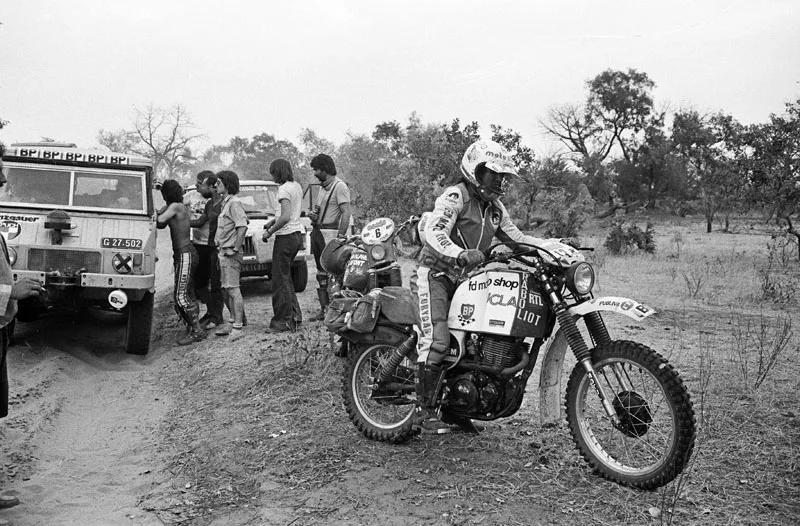
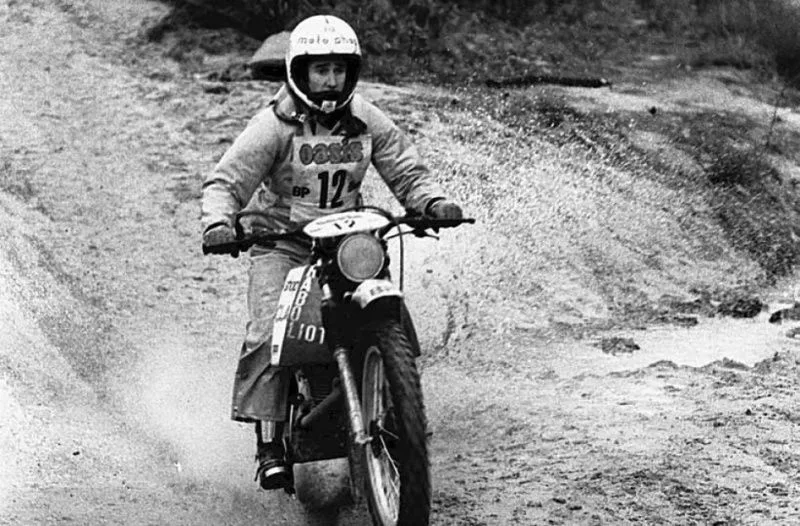
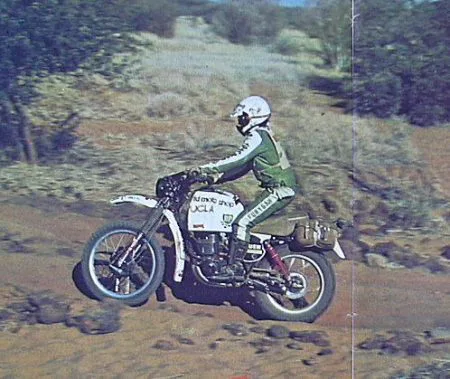
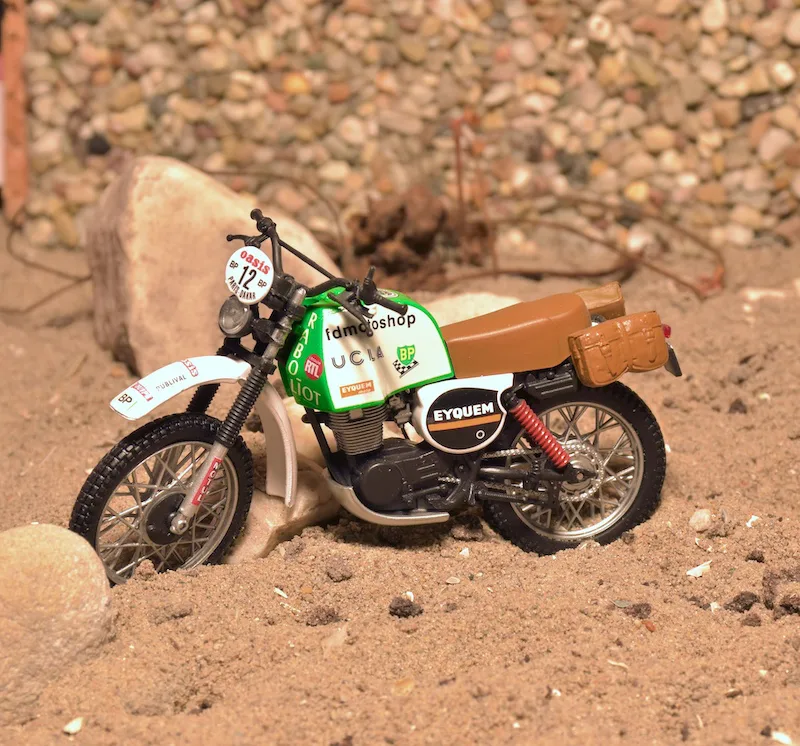
- DE AGOSTINI – #unknown (plastic, scale 1:24)
- Overall rating: 2 STARS | Quality details: 1 STAR | Estimated value: 1 STAR
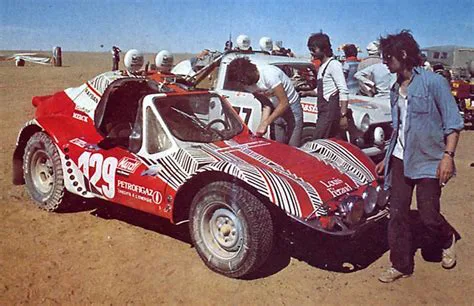
1979 Paris – Algers – Dakar, Sunhill Buggy. The first Dakar was a survival trip more than a race. Participants were looking for the best vehicle to cross the African continent and came up with odd vehicles such as a Renault 4 or Rolls Royce. Yves Sunhill built his own little 2 wheel-drive buggy in which he competed no less than 5 Dakars. The best solution in the end was just a near standard 4WD Range Rover V8 that won the car category.
#129 Yves Dunhill (F) / Jen-Paul Sevin (F) – DNF
Sunhill Buggy – 1.8 liter Renault straight-4, approximately. 90 hp. Weight 6530 kg. Gates tires. Steel space frame, chassisnr. 1102610268. 2WD
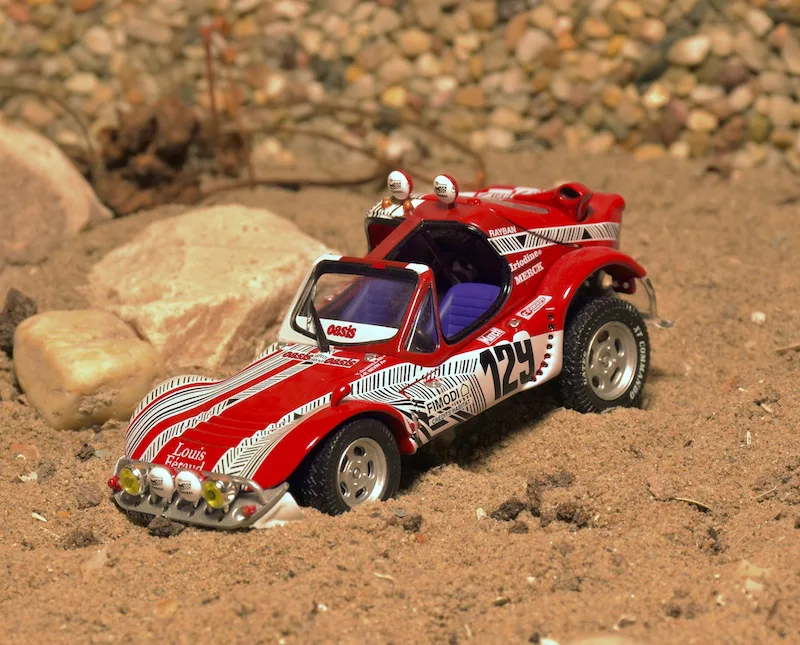
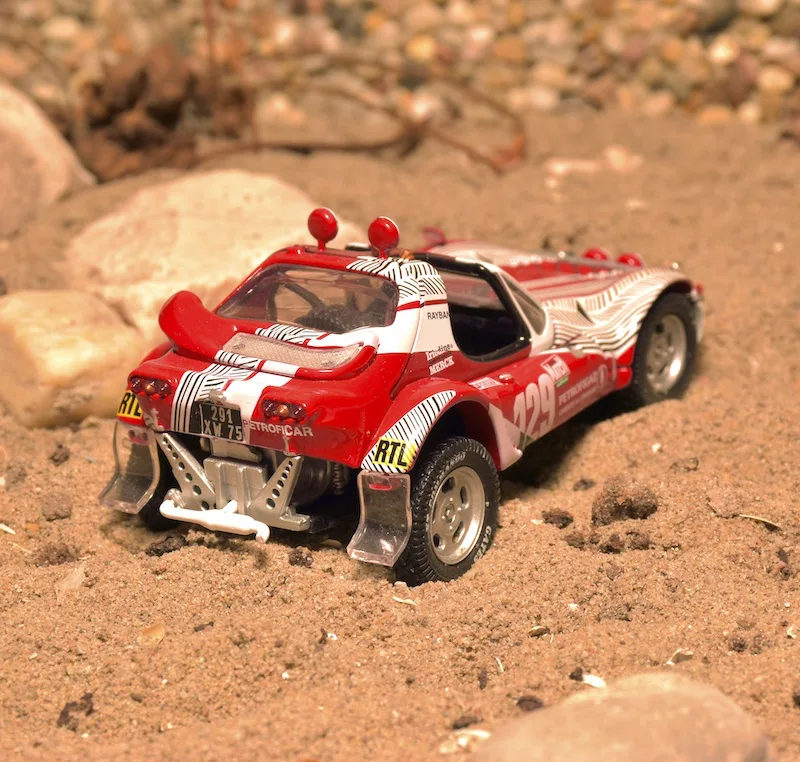
- NOREV Le Légende du Dakar 34 (diecast)
- Overall rating: 3 STARS | Quality details: 2 STARS | Estimated value: 2 STARS
1979 Paris – Algers – Dakar, Range Rover. The first Dakar which was a survival trip more than a race in the first year. Participants were looking for the best vehicle to cross the African continent and came up with odd vehicles such as a Renault 4 or Rolls Royce. A near standard Range Rover with V8 engine and 4WD appeared to be the best solution, it finished 4th overall and first in the car category. There were three man on board, apparently one was just sitting in the rear and all their luggage was in the boot …
#162 Alain Génestrier (F) / Joseph Terbiaut (F) / Jean Lemordant (F) – 4th / st car
Range Rover – 3.5 liter Rover V8 carburetors, approx. 135 hp. Michelin tires. Weight 1700 kg. Steel monocoque, chassisnr. unknown. 4WD
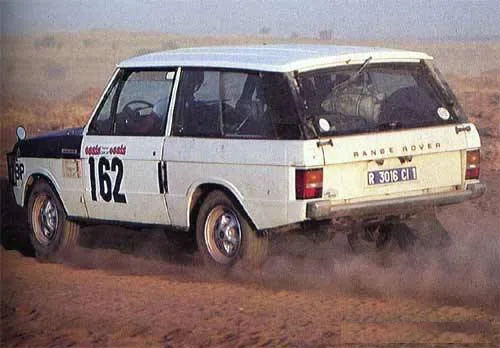
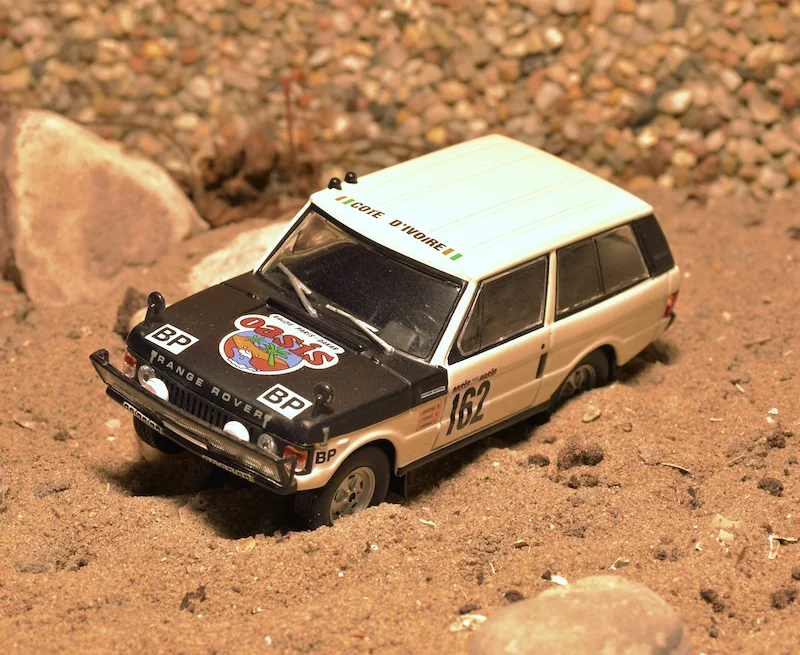
- NOREV Le Légende du Dakar 16 (diecast)
- Overall rating: 3 STARS | Quality details: 2 STARS | Estimated value: 2 STARS
1980 Paris – Algers – Dakar, Volkswagen iltis. The Rally Dakar was an instant hit, well known drivers and manufacturers were interested already in the second edition. Volkswagen was the first factory team that participated; Four Volkswagen Iltis were entered. Originally it is a military vehicle, just as the Jeep was 40 years earlier. The design of this four-wheel drive system provided the basis for Audi’s Quattro system that would be introduced four years later. If you watch closely, the car had Ingolstadt number plates, Audi’s home town. The standard 75 hp powerplant was replaced by a Golf GTi engine. Kottulinsky won after a hard battle with the Marreau brothers. The other Iltis’ finished 2nd, 4th and 9th.
#137 Freddy Kotulinsky (D) / Fred Luffelman (D) – 1st
VW Motorsport – 1.8 liter Volkswagen straight-4, approx. 110 hp. Uniroyal tires. Weight 1300 kg. Steel monocoque, chassisnr. #unknown. 4WD
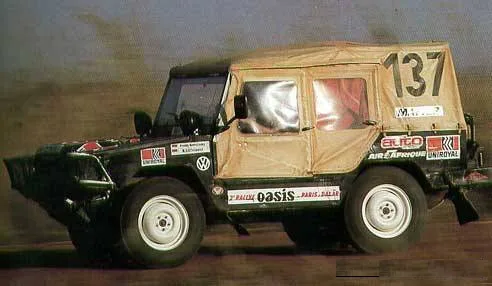
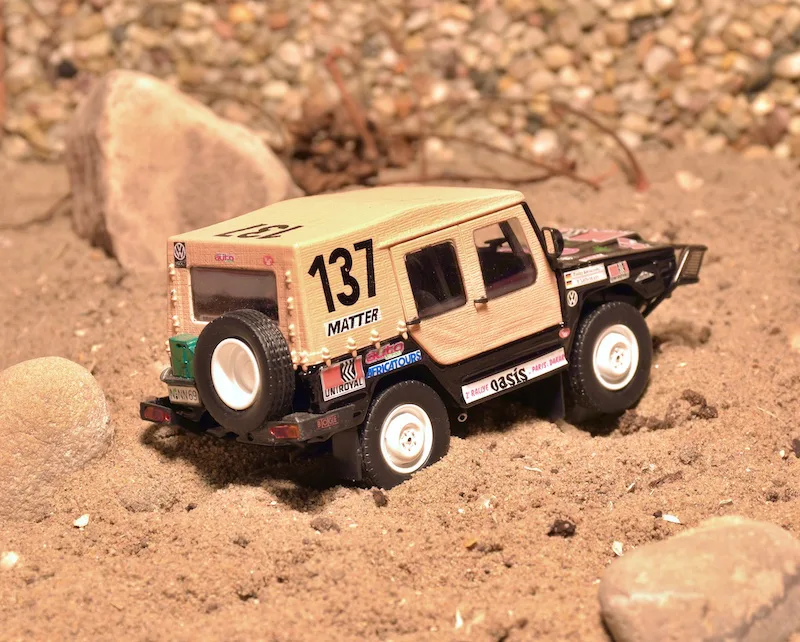
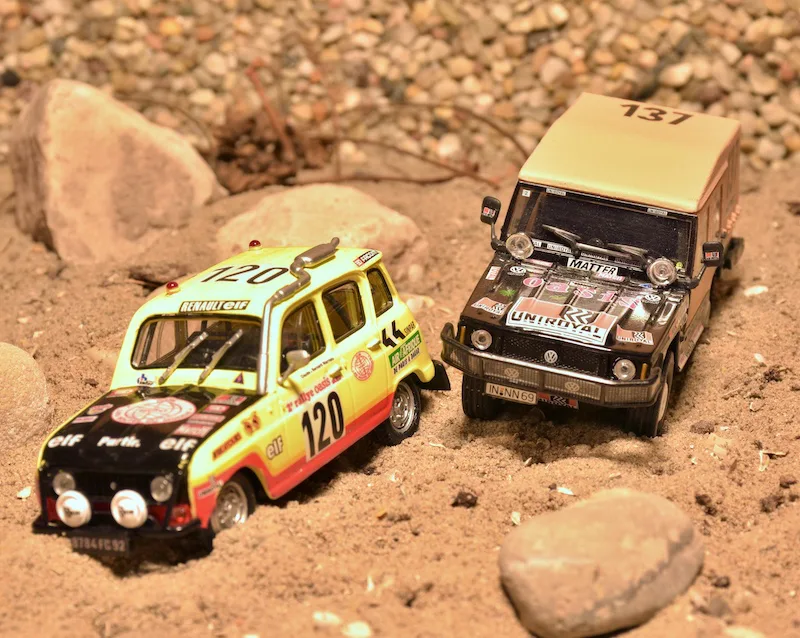
- NOREV Le Légende du Dakar 4 (diecast + plastic)
- Overall rating: 3 STARS | Quality details: 2 STARS | Estimated value: 2 STARS
1980 Paris – Algers – Dakar, Renault 4 Sinpar. Volkswagen was the first factory team that participated and took victory in 1980. But to reach that they had to defeat these guys, the ‘desert foxes’, the Marreau brothers in their Renault 4 Sinpar. It had all wheel drive and the engine of a group 2 Renault 5 Alpine, it finished 3rd. Previous year they already finished second in the cars category.
#120 Claude Marreau (F) / Bernard Marreau (F) – 3rd
Frères Marreau Renault 4 Sinpar – 1.4 liter Renault straight-4, approx. 120 hp. Uniroyal tires. Weight 1100 kg. Steel monocoque, chassisnr. #unknown. 4WD.
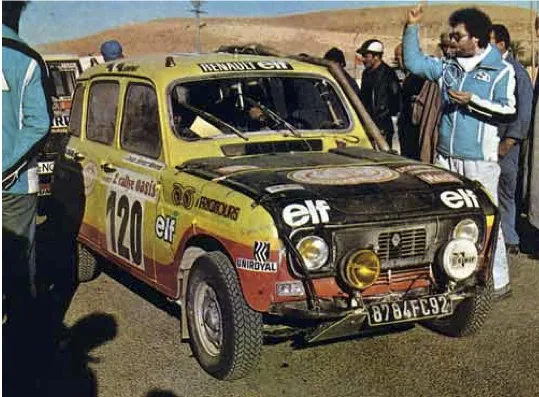
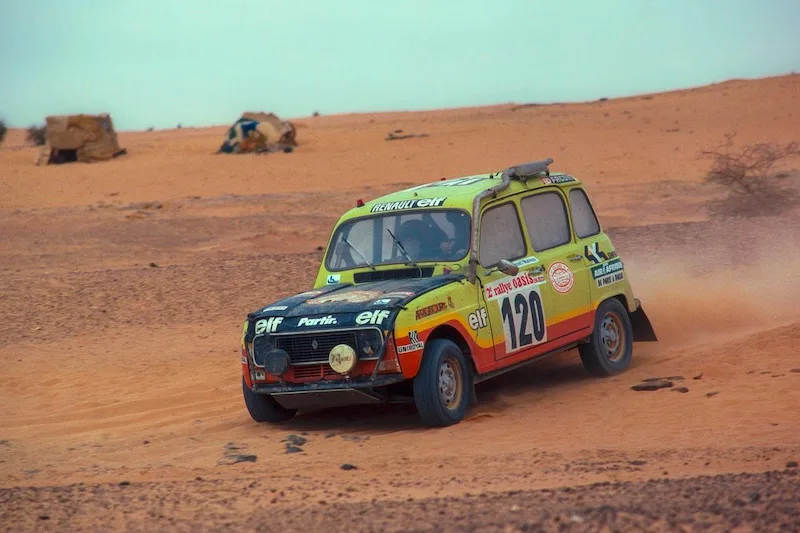
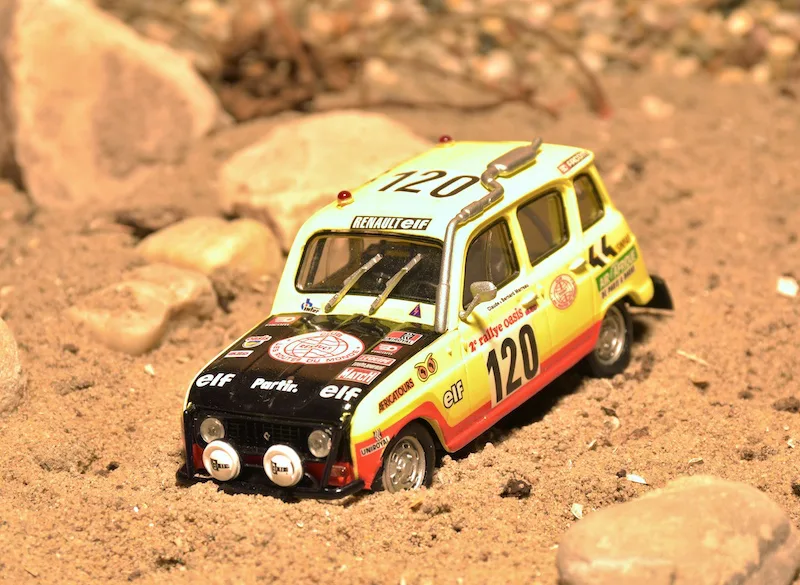
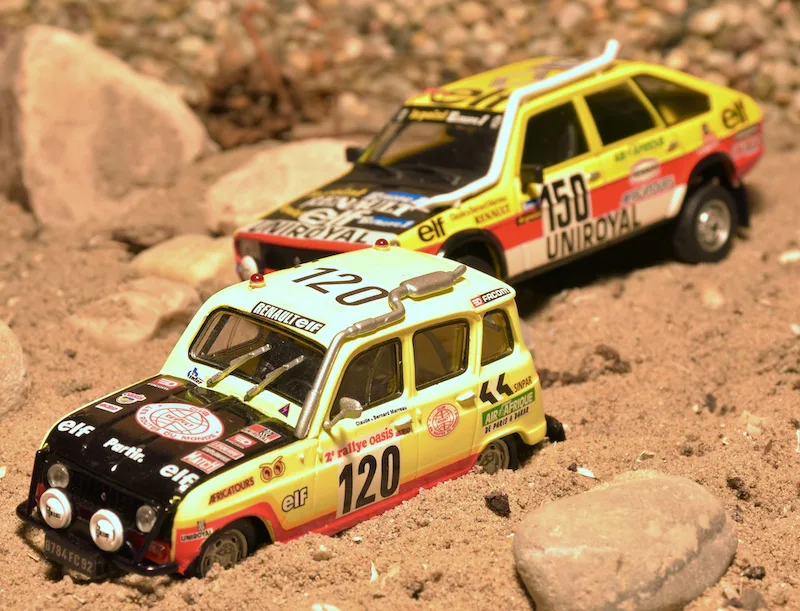
- NOREV Le Légende du Dakar 19 (diecast)
- Overall rating: 3 STARS | Quality details: 2 STARS | Estimated value: 2 STARS
1981 Paris – Algers – Dakar, Range Rover. It was only the third Dakar Raid, but the big names in motorsport already got interested. French racer Rene Metge won with his TWR-prepared Range Rover, beating Le Mans ace Jacky Ickx in a Citroën who made his dessert debut.
#212 Rene Metge (F) / Bernard Giroix (F) – 1st
TWR Range Rover – 3.5 liter Rover V8 injection, approx. 160 hp. Michelin tires. Weight 1700 kg. Steel monocoque, chassisnr. unknown. 4WD
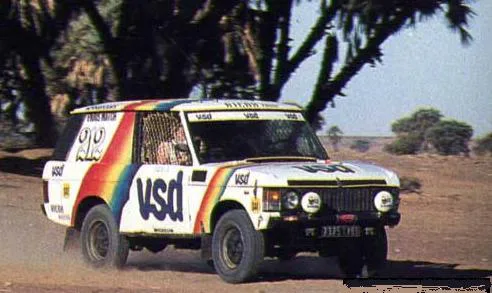
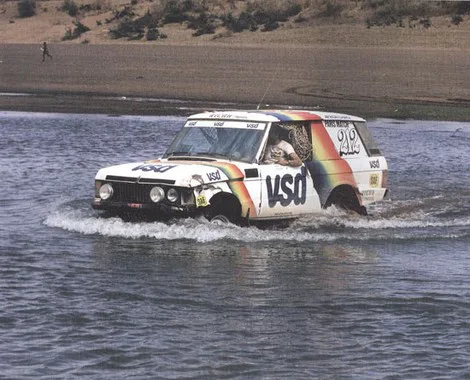
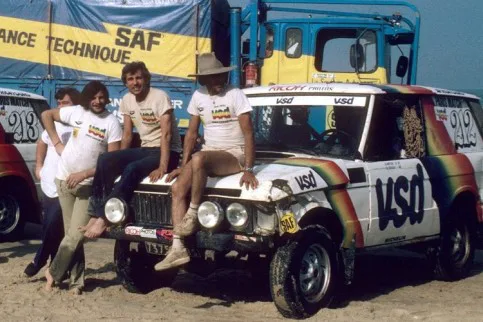
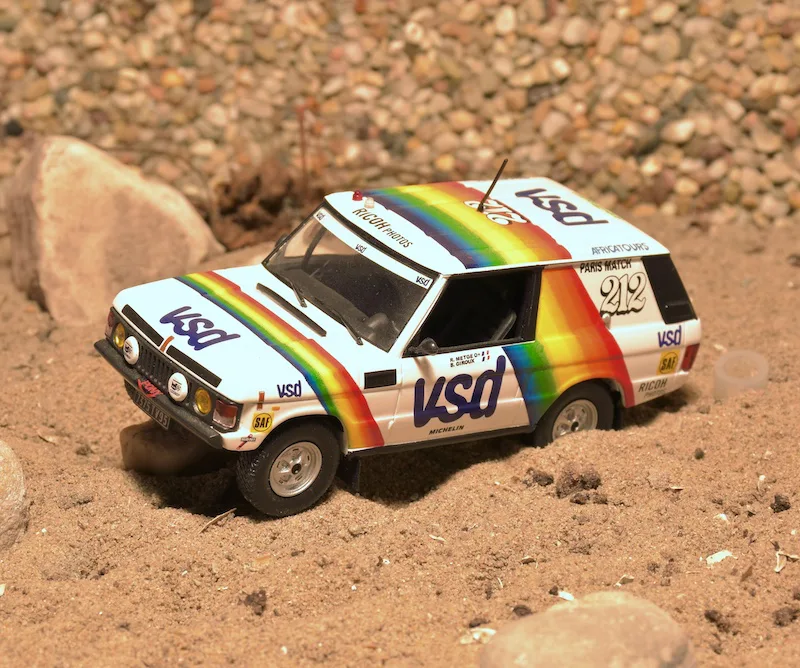
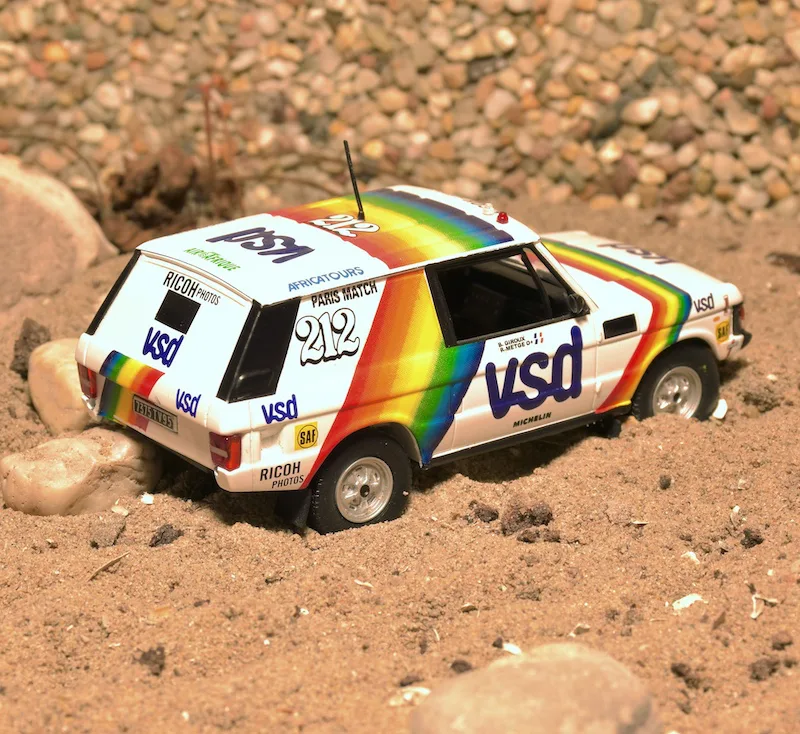
- SKID #42 (diecast)
- Overall rating: 3 STARS | Quality details: 2 STARS | Estimated value: 2 STARS
1981 Paris – Algers – Dakar, Citroën CX. Multiple Le Mans and Grand Prix winner Jacky Ickx made his debut in Le Dakar this year. He drove this front-wheel drive Citroën CX together with actor Claude Brasseur. Ickx and Brasseur won one stage but didn’t make it to the finish. They would return and win the event in 1983.
#125 Jacky Ickx (B) / Claude Brasseur (F) – DNF
Citroën Belgium Citroën CX 2400 GTi – 2.4 liter Citroën straight-4 injection, approx. 160 hp. Michelin tires. Weight 1400 kg. Steel monocoque, chassisnr. unknown. FWD
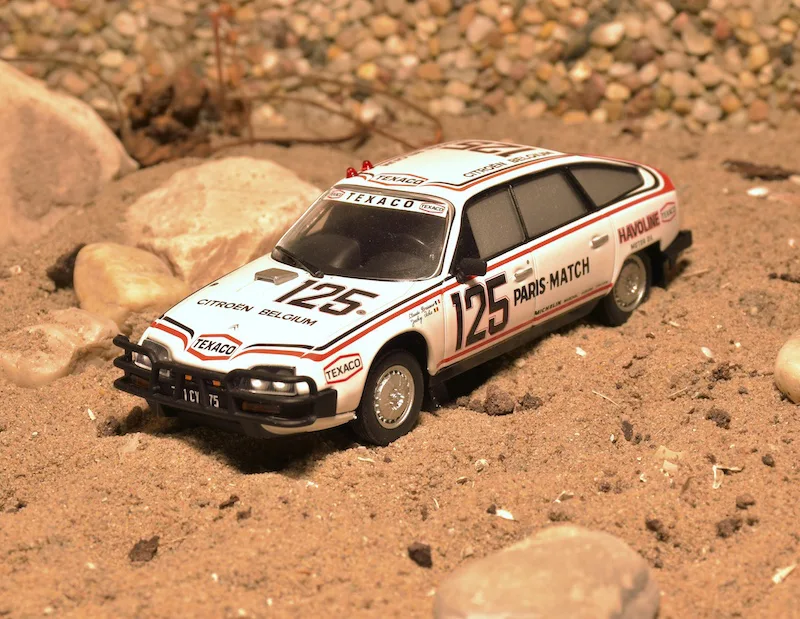
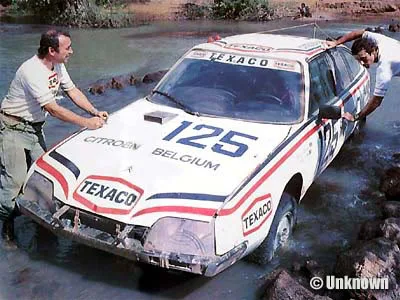
- NOREV Le Légende du Dakar 30 (diecast)
- Overall rating: 3 STARS | Quality details: 2 STARS | Estimated value: 2 STARS
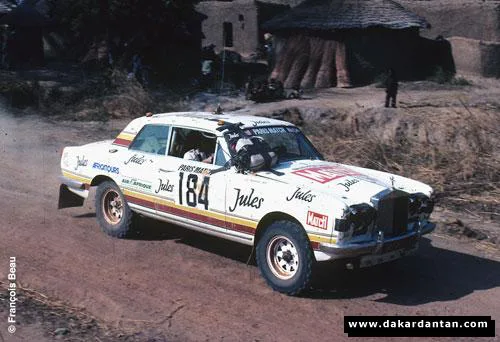
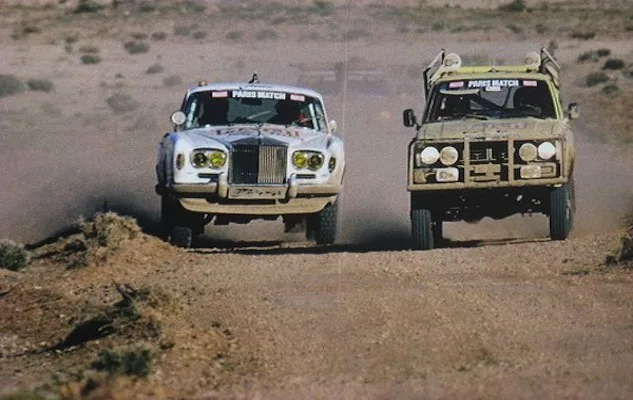
1981 Paris – Algers – Dakar, Jules Proto. The Rally Paris-Dakar was created by Thierry Sabine. At first it was more an adventure and survival than a race and attracted a mixed crowd, well known racing drivers but also some very strange people. This entrant belonged to the second category. Thierry de Montcorgé drove in what looked like a Rolls Royce Corniche Coupé, but was a tube frame fitted with a pair of Toyota Landcruiser axles and a Chevrolet V8 engine with automatic transmission. He drew quite some attention but didn’t finish the raid.
#184 Thierry de Montcorgé (F) / Jean-Christophe Pelletier (F) – DNF
Jules Proto – 5.7 liter Chevrolet V8, approx. 300 hp. tires unknown, weight 1500 kg. Steel space frame + kevlar body, chassisnr. Jules Proto I. 4WD
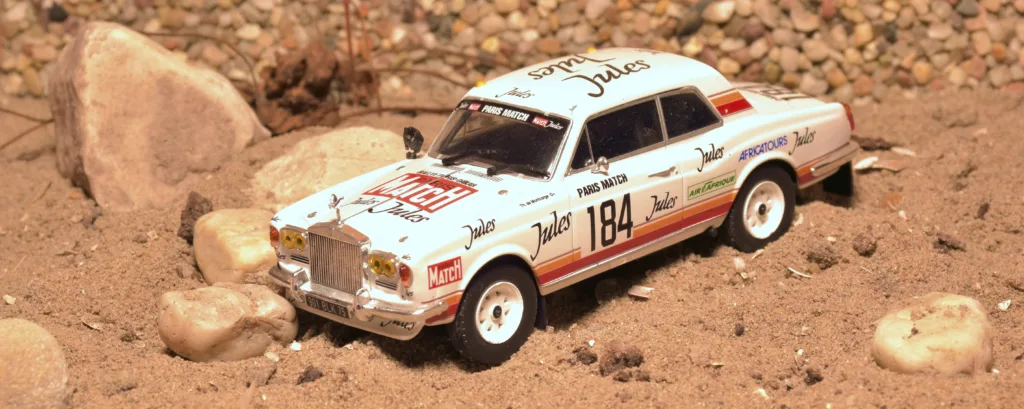
- NOREV Le Légende du Dakar 28 (diecast)
- Overall rating: 3 STARS | Quality details: 2 STARS | Estimated value: 2 STARS
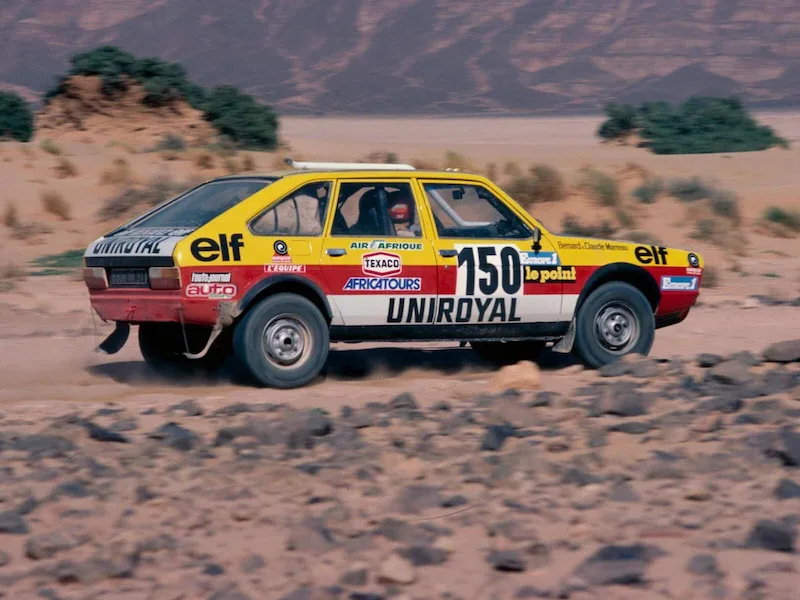
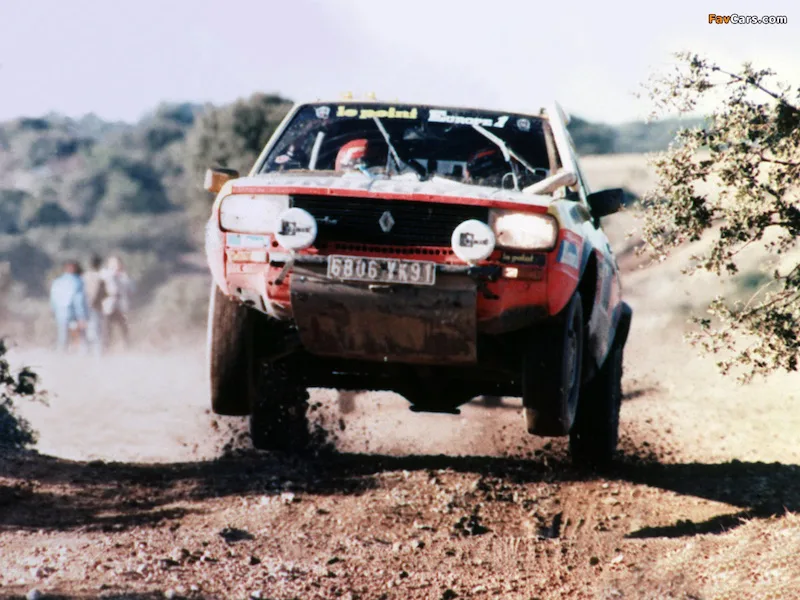
1982 Paris – Algers – Dakar, Renault 20 turbo 4×4. The Marreau brothers belong to the real Dakar pioneers. They already finished 2nd in 1979 and 3rd in 1980 with their little Renault 4. In 1982 they entered this Renault 20 4×4 with the engine from a R18 turbo. The brothers would win the Dakar however Jacky Ickx won more stages in his Mercedes G.
#150 Claude Marreau (F) / Bernard Marreau (F) – 3rd
Frères Marreau Renault 20 turbo 4×4 – 1.6 liter Renault straight-4 turbo, approx. 160 hp. Uniroyal tires. Weight 1430 kg. Steel monocoque, chassisnr. #unknown. 4WD.
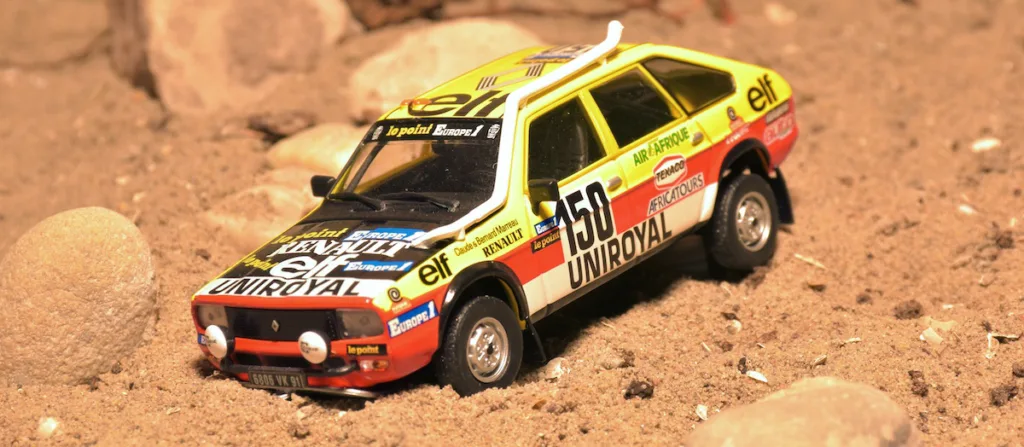
- NOREV Le Légende du Dakar 13 (diecast)
- Overall rating: 3 STARS | Quality details: 2 STARS | Estimated value: 2 STARS
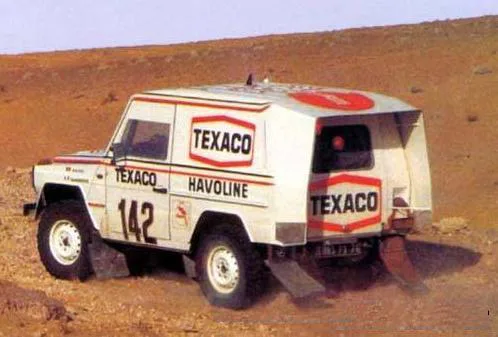
1983 Paris – Algers – Dakar, Mercedes-Benz 280 GE. ‘Mr Le Mans’ and Formula 1 star Jacky Ickx turned to Le Dakar. After his first attempt with the FWD Citroën, he choose a 4WD Mercedes GE as his next weapon. He almost won in 1982 and did so in 1983, both times again with French actor Claude Brasseur as his co-pilot.
#142 Jacky Ickx (B) / Claude Brasseur (F) – 1st
Mercedes-Benz 280 GE – 2.8 liter Mercedes M110 straight-6, approx. 210 hp. Michelin tires. Weight 1800 kg. Steel monocoque, chassisnr. unknown. 4WD
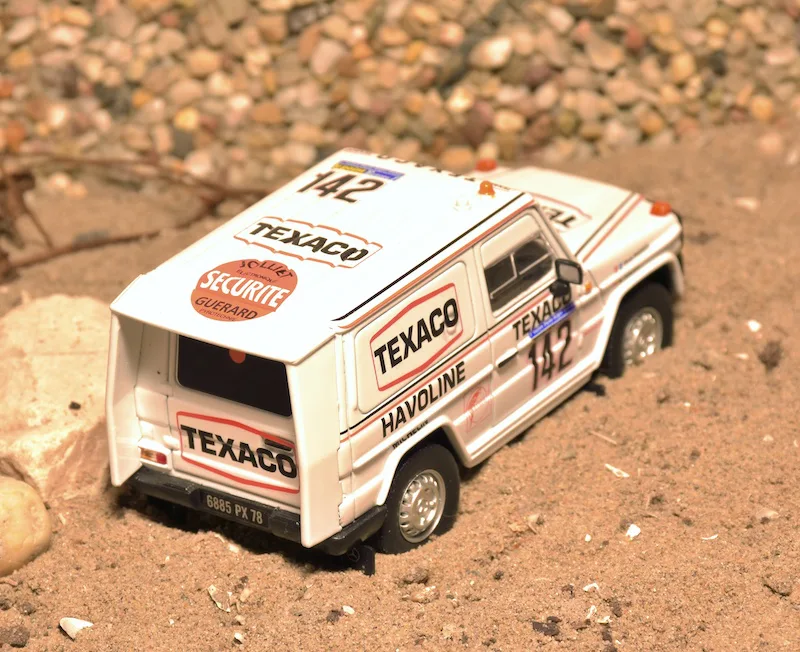
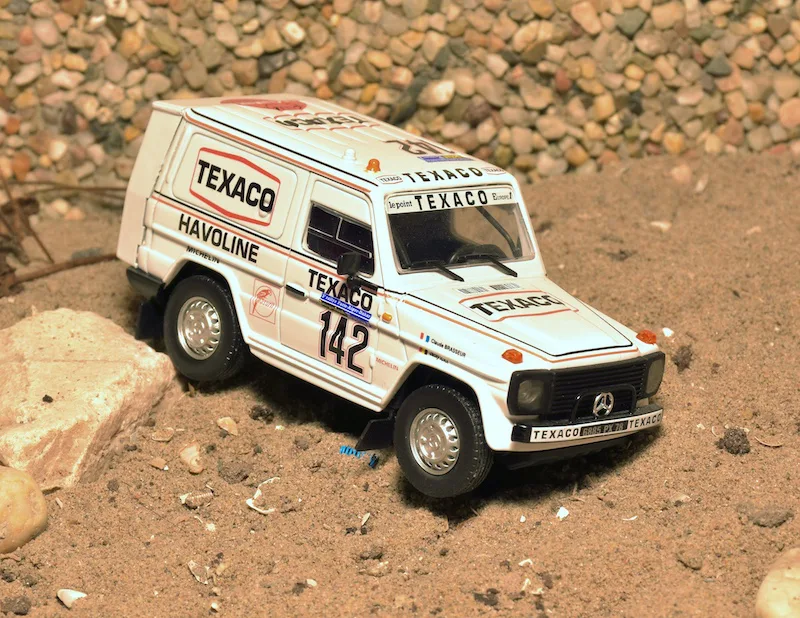
- NOREV Le Légende du Dakar 12 (diecast)
- Overall rating: 3 STARS | Quality details: 2 STARS | Estimated value: 2 STARS
1983 Paris – Algers – Dakar, Range Rover. Pierre Lartigue drove his privately entered Range Rover to 3rd place behind Ickx in the Mercedes GE and Trossat in a Lada! In a few years he would be a works driver for Mitsubishi and Citroën and win Le Dakar 4 times!
#158 Pierre Lartigue (F) / Patrick Destaillats (F) – 3rd
Range Rover – 3.5 liter Rover V8 injection, approx. 160 hp. Michelin tires. Weight 1700 kg. Steel monocoque, chassisnr. unknown. 4WD
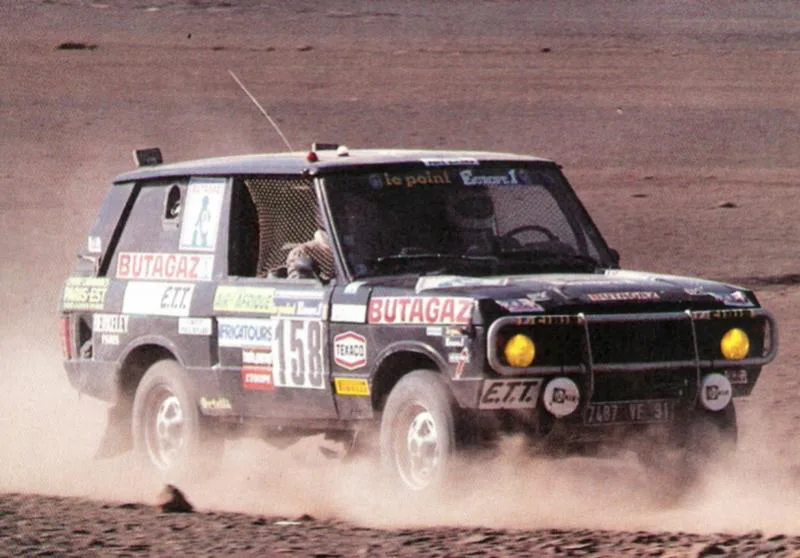
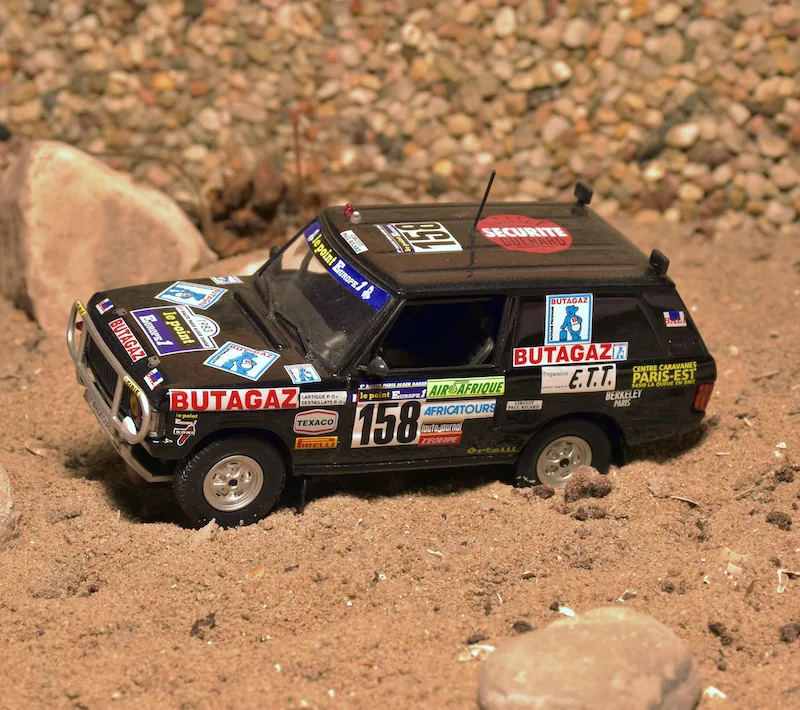
- IXO Classic Rallye Cars SKC042 (diecast)
- Overall rating: 3 STARS | Quality details: 3 STARS | Estimated value: 3 STARS
1984 Paris – Algers – Dakar, Porsche 911 SC 4×4. Porsche built this 911 that used the 4WD system from its successor the Porsche 959. René Metge and Dominique Lemoyne won Le Dakar in 1984. Their team mate Jacky Ickx was fastest in 1984, winning the highest number of special stages, but he only finished 6th.
#176 René Metge (F) / Dominique Lemoyne (F) – 1st
Porsche 911 SC 4×4 – 3.2 liter Porsche flat-6, approx. 265 hp. Dunlop tires. Weight 1165 kg. Steel monocoque, chassisnr. unknown. 4WD
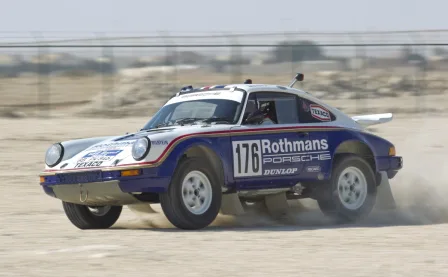
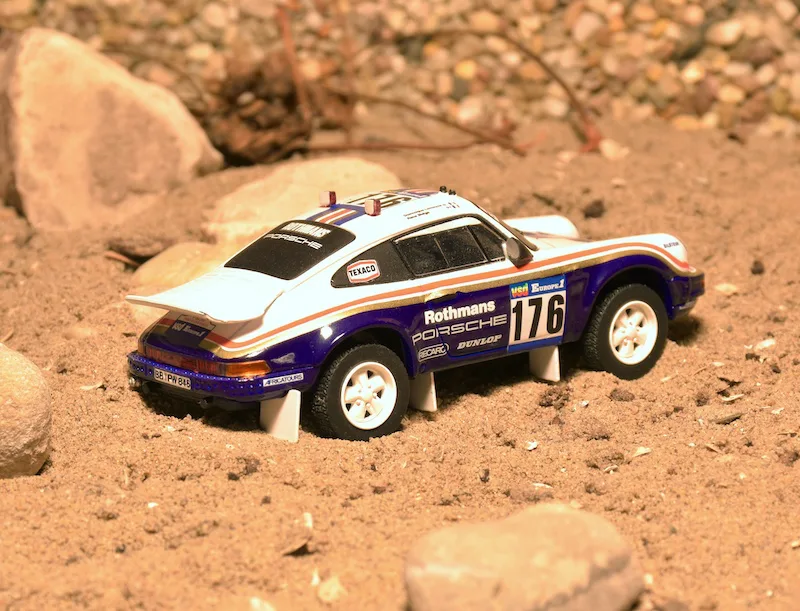
- NOREV Le Légende du Dakar 7 (diecast)
- Overall rating: 3 STARS | Quality details: 2 STARS | Estimated value: 3 STARS
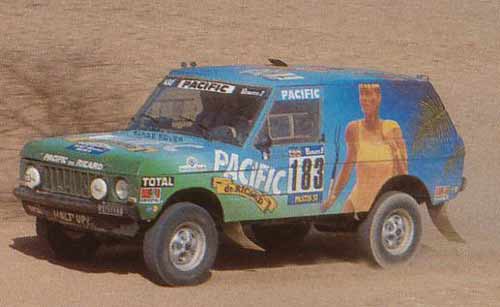
1984 Paris – Algers – Dakar, Range Rover. The Raid Paris-Dakar was dominated by theRené Metge’s Porsche in 1984. It was a completely different car than the 4×4’s we were used to see such as Range Rover and Mercedes G. It would be the turning point in the history of Dakar, where it became far more professional. Among the previous generation participants this ‘old style’ Range Rover from Gabreau and Gabbay that finished 11th.
#183 Jean-Pierre Gabreau (F) / Alain Gabbay (F) – 11th
Team Pacific Range Rover – 3.5 liter Rover V8 injection, approx. 160 hp. Uniroyal tires. Weight 1700 kg. Steel monocoque, chassisnr. unknown. 4WD
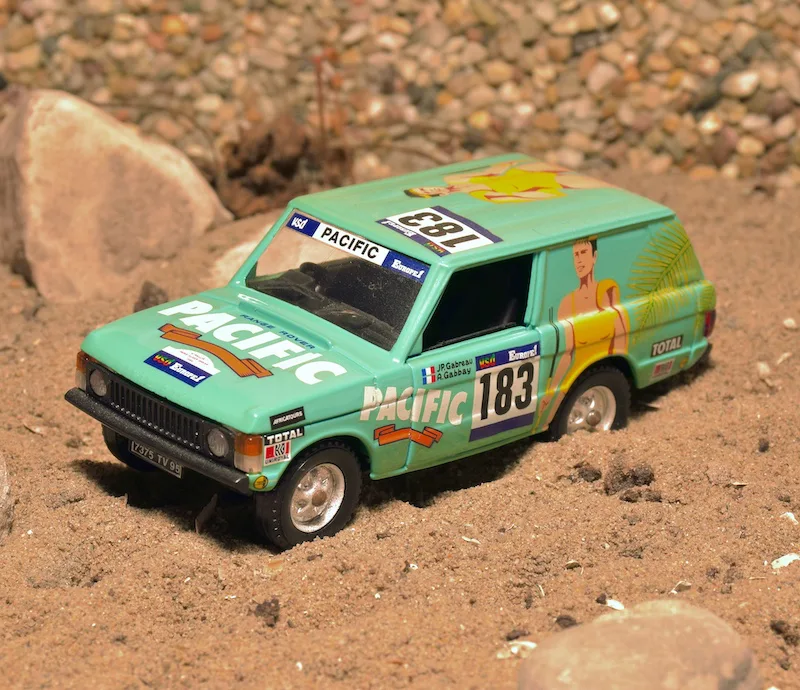
- SOLIDO 1927 (diecast)
- Overall rating: 2 STARS | Quality details: 1 STAR | Estimated value: 2 STARS
1984 Paris – Algers – Dakar, Jules Proto II. Thierry de Montcorgé was an eye-catcher in 1981 with his ‘Rolls Royce’ Proto. In 1984 he returned with the even more lunatic Jules Proto II. It was again powered by a Chevrolet V8 engine and had its 4 rear wheels driven through a Porsche gearbox. The revolutionary kevlar enforced chassis looked great, but when it broke in the middle of the desert, it couldn’t be repaired.
#197 Thierry de Montcorgé (F) / Jean-Pierre Nicolle (F) – DNF
Jules Proto II – 5.7 liter Chevrolet V8, approx. 350 hp. Michelin tires, weight 1550 kg. Steel + kevlar space frame, chassisnr. Jules Proto II. 4WD
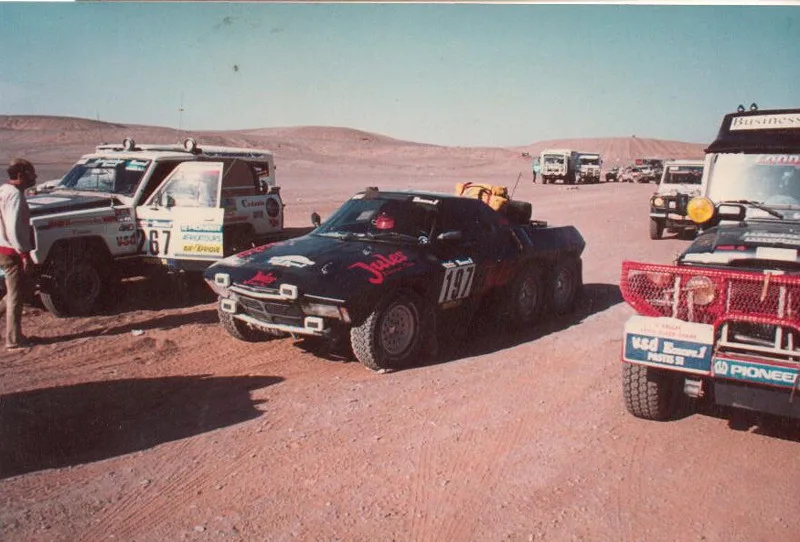
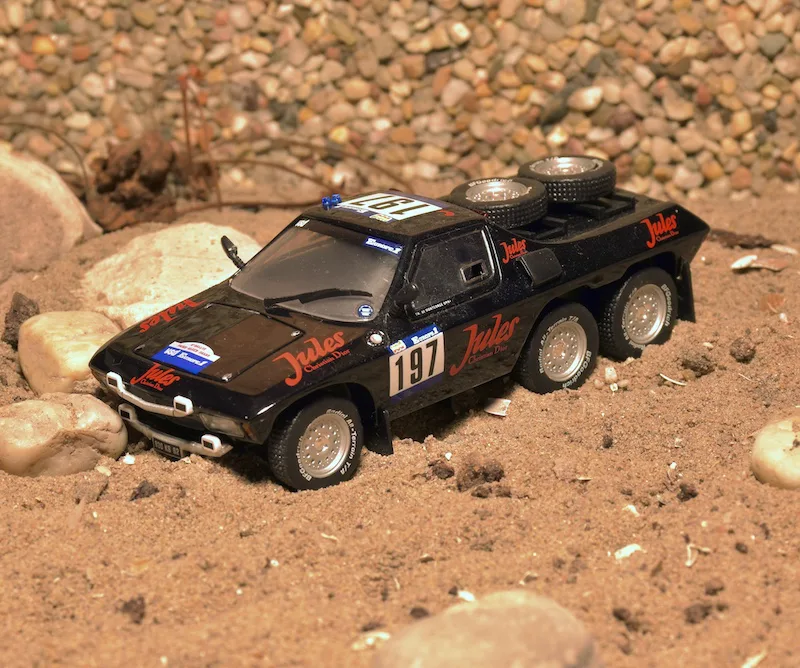
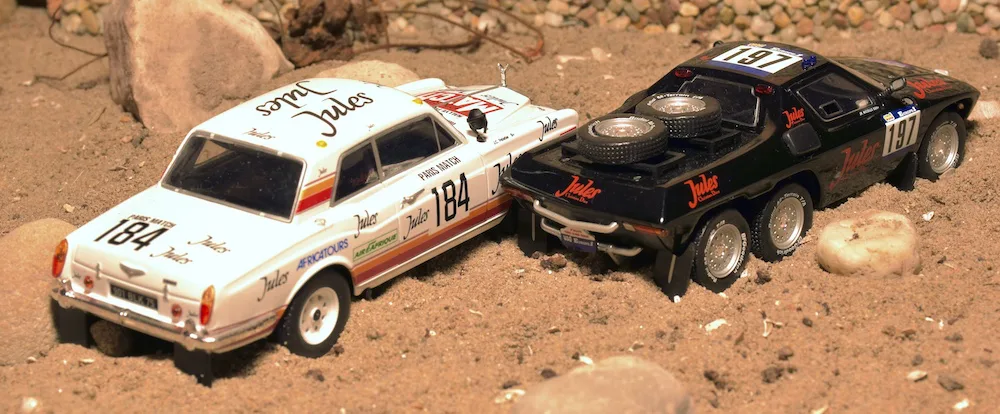
- NOREV Le Légende du Dakar 27 (diecast)
- Overall rating: 3 STARS | Quality details: 3 STARS | Estimated value: 3 STARS
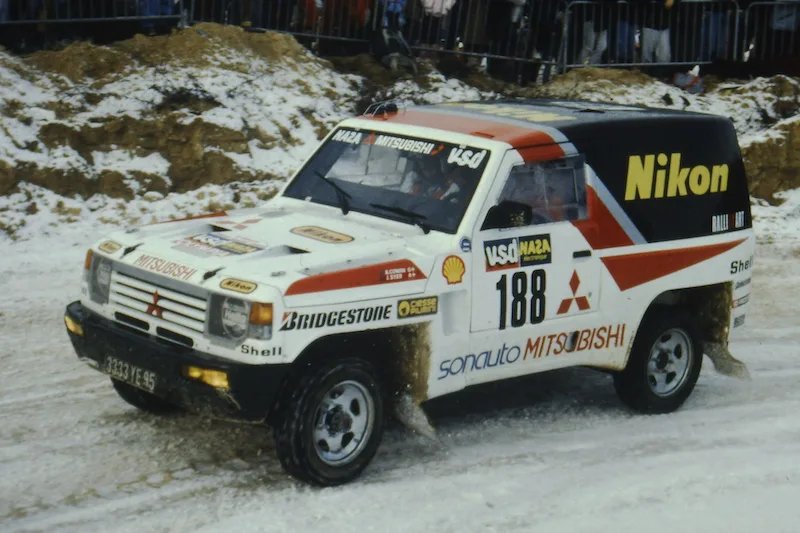
1985 Paris – Algers – Dakar, Pajero Mitsubishi and Dakar go back until 1983 when Andrew Cowan won the marathon class. Cowan finished 2nd this year behind Patrick Zaniroli. Both Mitsubishi’s took profit from the retirement of the new Porsche 959’s.
#189 Patrick Zaniroli (F) / Jean da Silva (F) – 1st
RalliArt Mitsubishi Pajero – 2.6 liter Mitsubishi 4G54 straight-4 turbo, approx. 220 hp. Bridgestone tires. Weight 1300 kg. Steel ladder chassis, chassisnr. SBM #unknown. 4WD
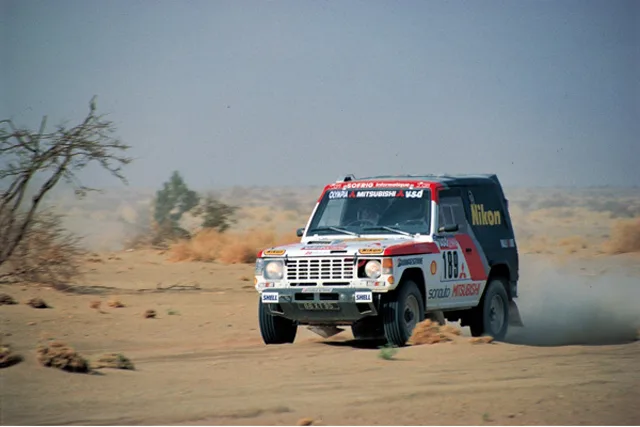
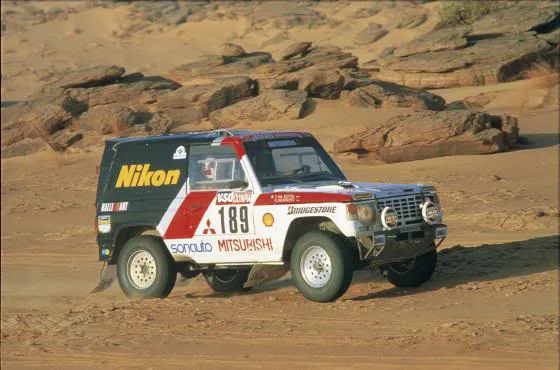
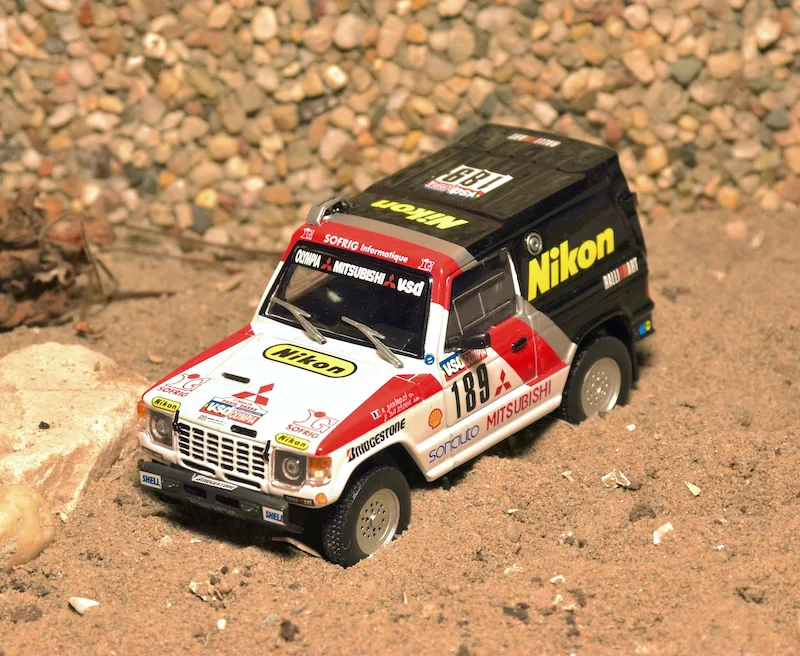
- NOREV Le Légende du Dakar 11 (diecast)
- Overall rating: 3 STARS | Quality details: 3 STARS | Estimated value: 2 STARS
1985 Paris – Algers – Dakar, Renault 18 break 4×4. The Marreau brothers belong to the real Dakar pioneers. They finished 2nd in 1979 and 3rd in 1980 with their little Renault 4. In 1982 they won with their Renault 20 turbo 4×4. The next 3 years they competed in this Renault 18 break with V6 engine. This year they finished 5th just as in the previous year.
#205 Claude Marreau (F) / Bernard Marreau (F) – 5th
Frères Marreau Renault 18 break 4×4 – 2.7 liter Renault V6, approx. 185 hp. Michelin tires. Weight 1400 kg. Steel monocoque, chassisnr. #unknown. 4WD.
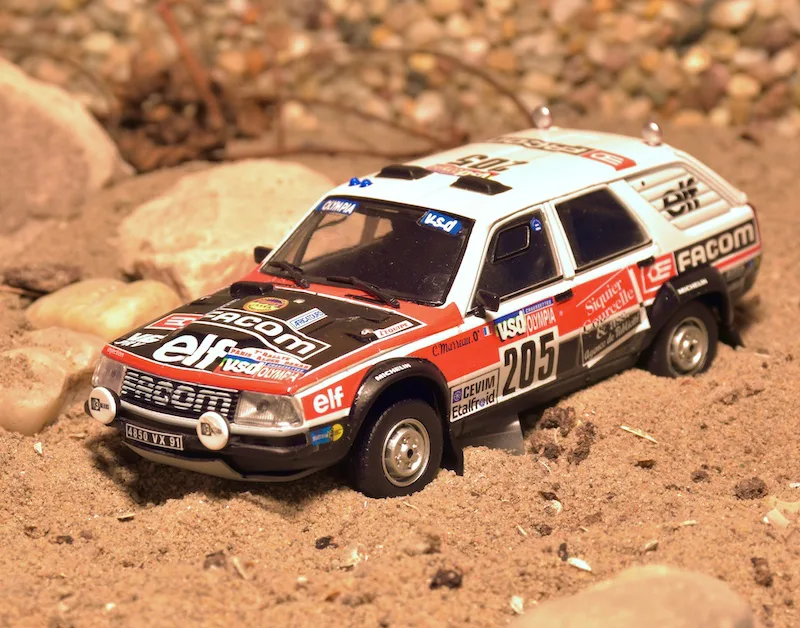
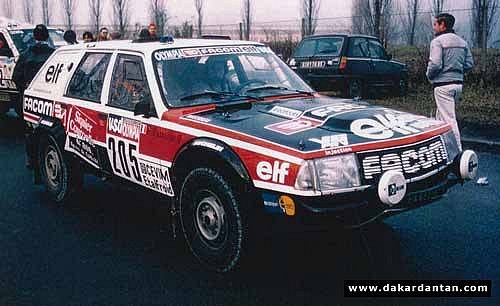
- NOREV Le Légende du Dakar 24 (diecast)
- Overall rating: 3 STARS | Quality details: 2 STARS | Estimated value: 2 STARS
Professionalization
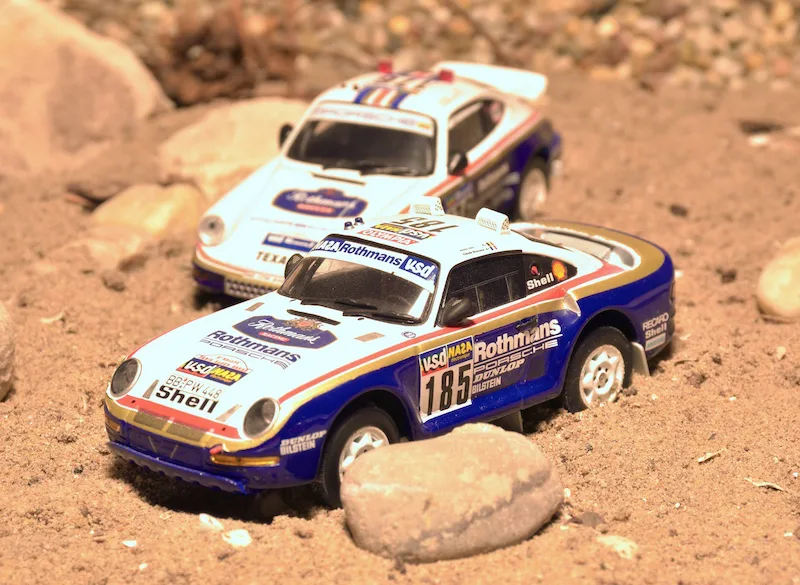
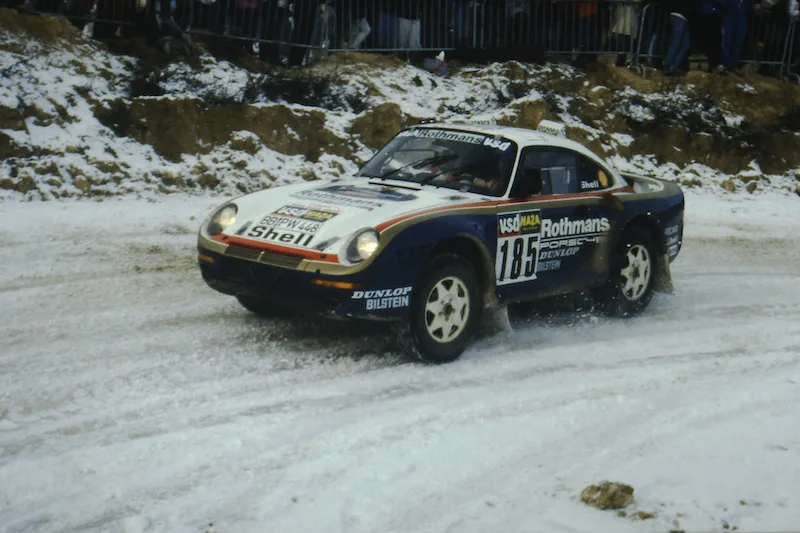
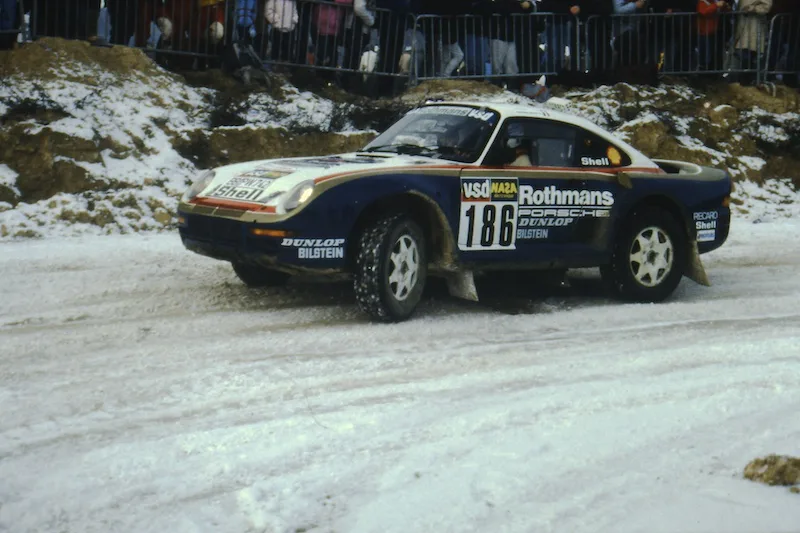
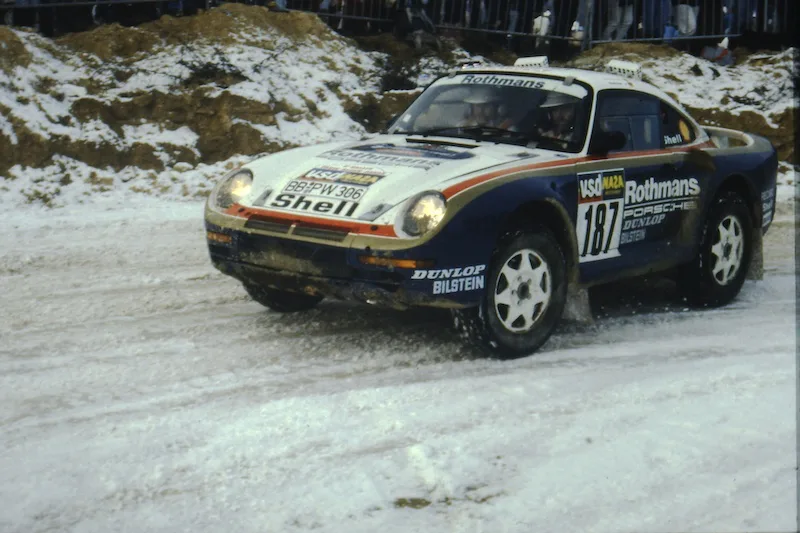
1986 Paris – Algers – Dakar, Porsche 959. The Porsche 959 was a special Dakar Rallye prototype, based on the 911 4×4 that won the rallye in 1984. The 959’s retired in 1985, but were very successful in 1986 with 1st, 2nd and 5th places. The turbo-boost was lowered because of the low octane fuel in Africa, so it delivered ‘only’ 390 hp instead of the original 450. Rene Metge won again, Jacky Ickx finished 2nd.
#185 Jacky Ickx (B) / Claude Brasseur (F) – 2nd
Porsche 959 Dakar – 2.8 liter Porsche flat-6 twin turbo, approx. 390 hp. Dunlop tires. Weight 1260 kg. Steel monocoque, chassisnr. unknown
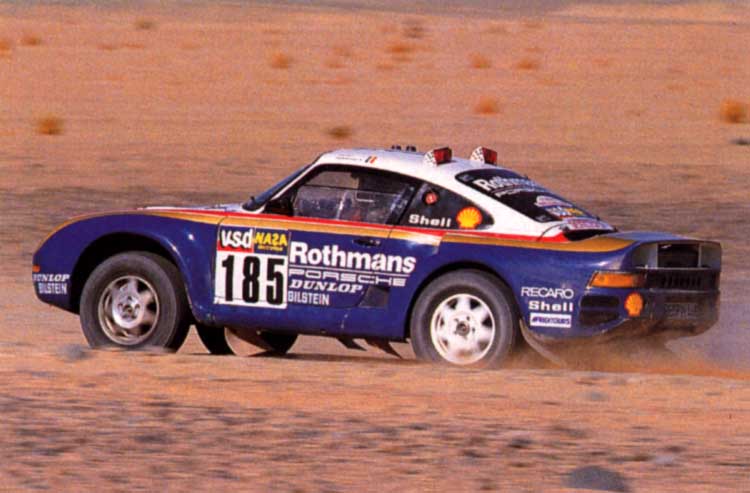
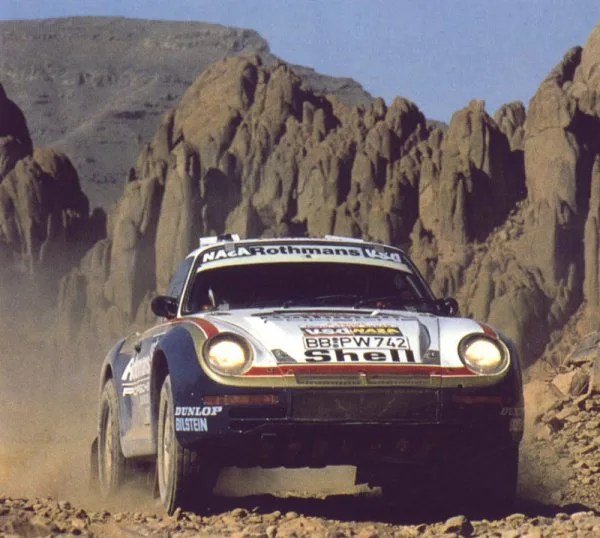
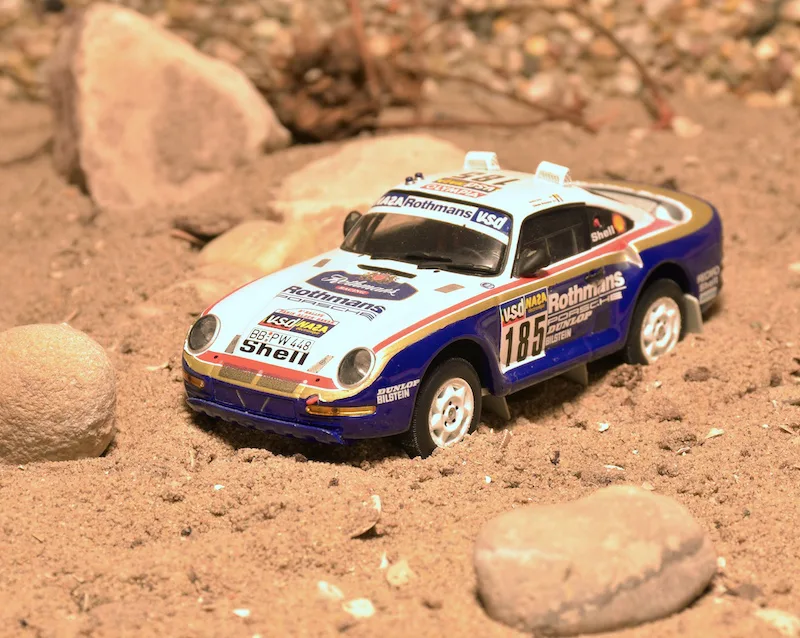
- MINICHAMPS MC400 866285 (diecast)
- Overall rating: 3 STARS | Quality details: 3 STARS | Estimated value: 3 STARS
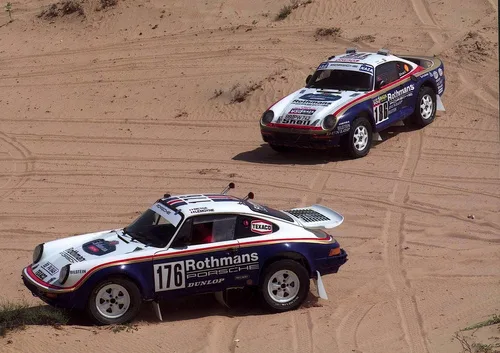
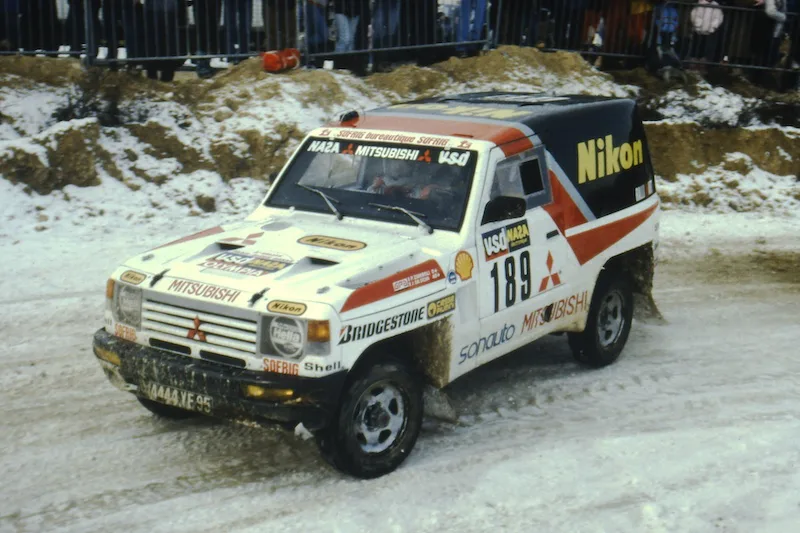
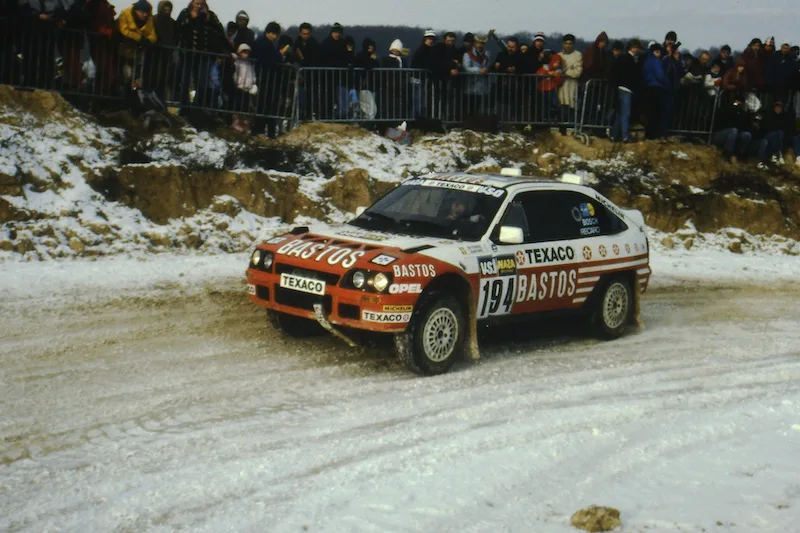
I was lucky enough to be present during the Dakar 1986 prologue in Cergy Pontoise at December 29th 1985 and saw the Porsches and Pajero’s slide on a cold and icy track.
Enjoy my pics 😉
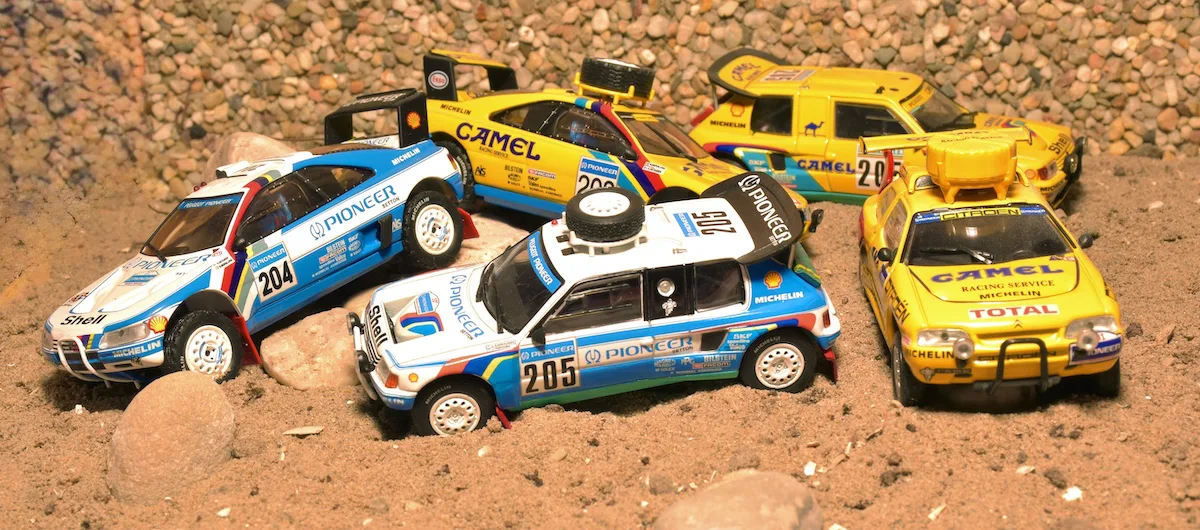
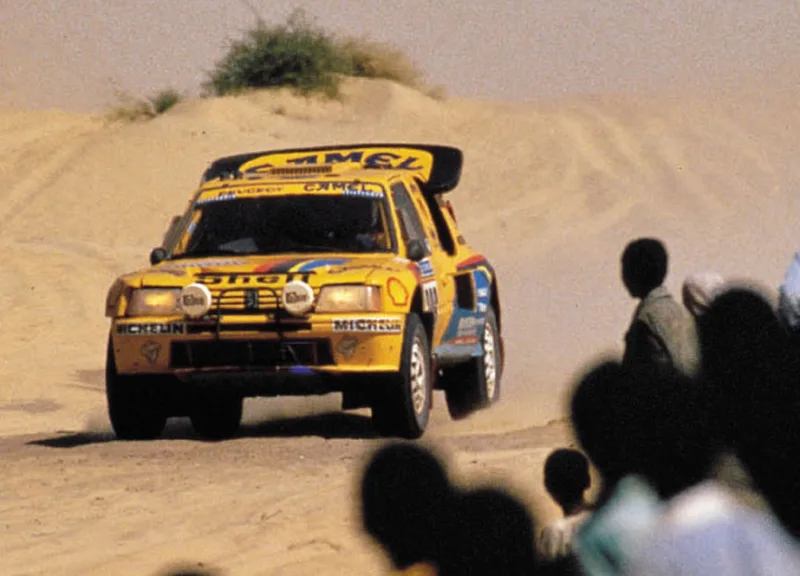
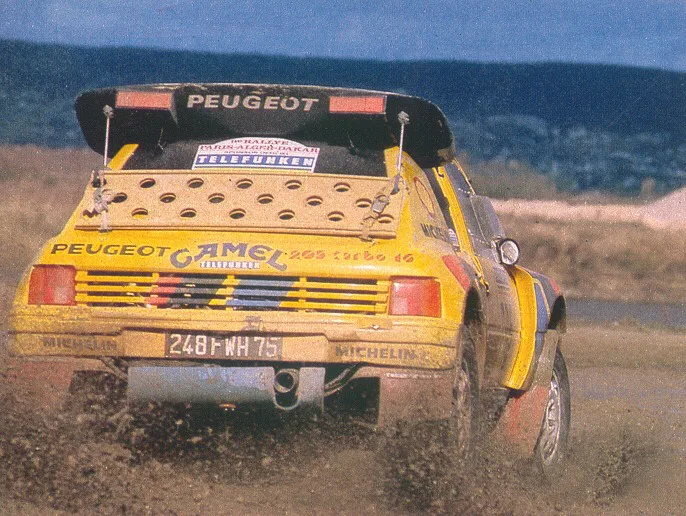
1987 Paris – Algers – Dakar, Peugeot 205 turbo 16. After the group B cars were banned in 1986, Peugeot turned to Dakar. The 205 turbo 16 was a good starting point, but had to get much more ride height, a longer wheelbase, a bigger fuel tank, a somewhat larger but detuned engine for more torque and reliability. The result was a car that was 400 kg heavier than the group B rally car, but very well suited to the Dakar rally. Ari Vatanen (world rally champion 1981) drove the Peugeot to victory in Dakar and three more would follow. His co-pilot in 1987 was Bernard Giroix who already won Dakar in 1981 in together with René Metge.
#205 Ari Vatanen (FIN) / Bernard Giroix (F) – 1st
Peugeot Sport Peugeot 205 turbo 16 – 1.9 liter PSA XU9T straight-4 turbo, approx. 360 hp. Michelin tires. Weight 1360 kg. Steel monocoque with subframes, chassisnr. unknown. 4WD
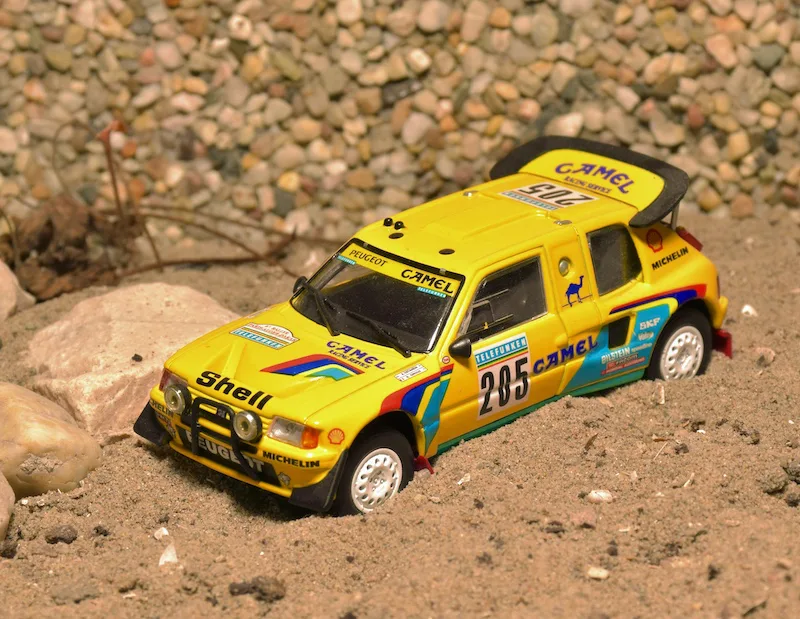

- NOREV Le Légende du Dakar 1 (diecast)
- Overall rating: 3 STARS | Quality details: 3 STARS | Estimated value: 2 STARS
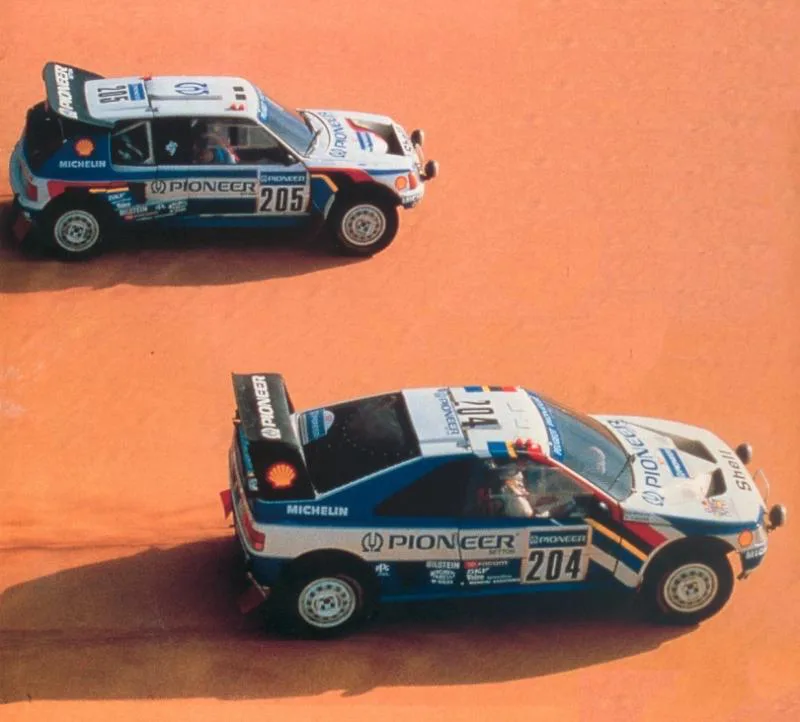
1988 Paris – Algers – Dakar, Peugeot 205 turbo 16. A new main sponsor and a new car, the Peugeot 405 coupe for Vatanen. That other ‘Flying Finn’ Juha Kankkunen, world rally champion with Peugeot, made his debut in the Dakar in last year’s 205. After Vatanen’s disqualification, Kankkunen took victory in his first and only Dakar in the 205 T16.
#205 Juha Kankkunen (FIN) / Juha Piironen (FIN) – 1st
Peugeot Sport Peugeot 205 turbo 16 – 1.9 liter PSA XU9T straight-4 turbo, approx. 360 hp. Michelin tires. Weight 1360 kg. Steel monocoque with subframes, chassisnr. unknown. 4WD
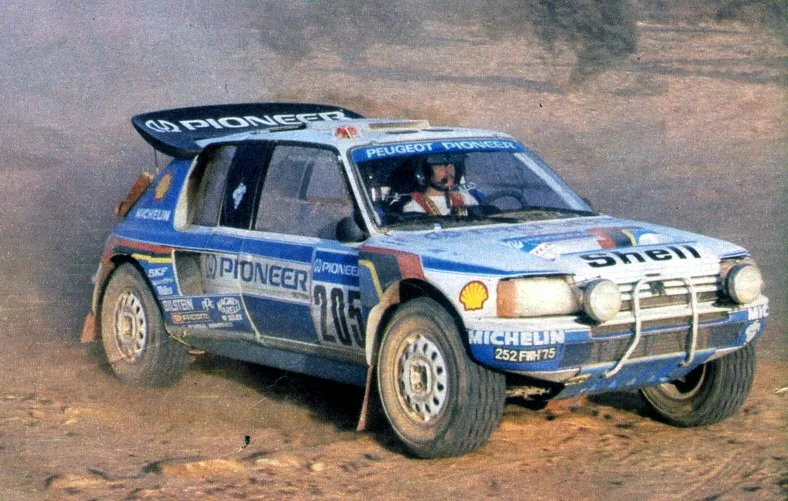
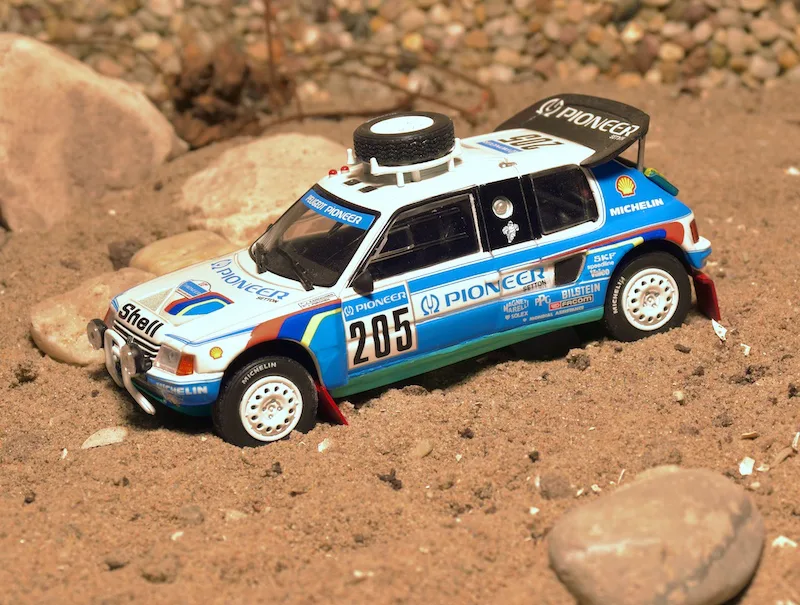
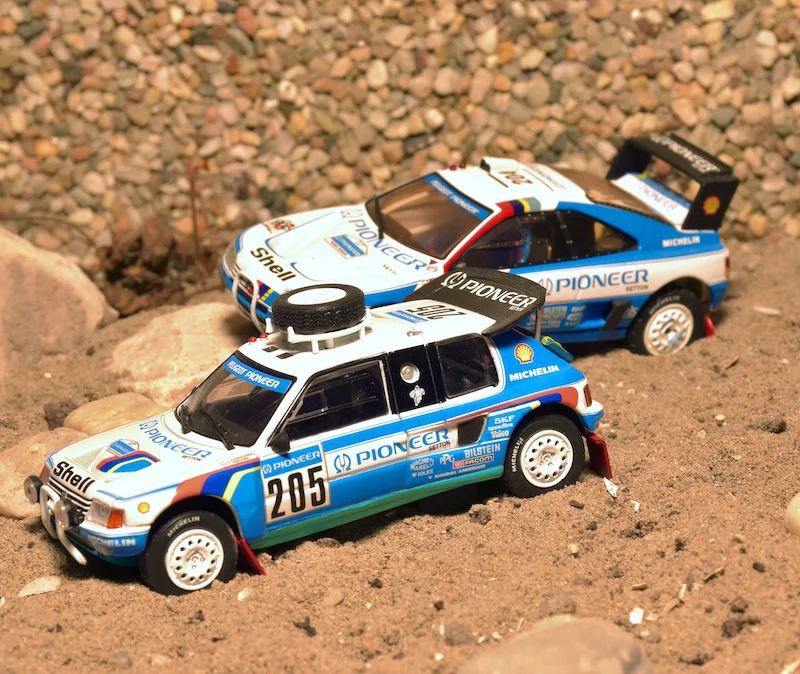
- NOREV Le Légende du Dakar 9 (diecast)
- Overall rating: 3 STARS | Quality details: 3 STARS | Estimated value: 2 STARS
1989 Paris – Tunis – Dakar, Peugeot 405 “Grand Raid”. Last year Ari Vatanen competed in the new Peugeot 405. It had the same platform and wheelbase as the 205 T16 but was somewhat lighter, more powerful and aerodynamic. In 1988, Ari was leading the rally in the new 405 but his engine was giving trouble. In Mali, his car got ‘stolen’ from the bivouac and found back in the morning with a engine that sounded much better … Of course Vatanen got disqualified and his team mate Kankkunen won. In 1989 Vatanen was eager to win again and rolled the Peugeot 405 in the prologue, but he was able to continue and win the rally after all. Kankkunen had been replaced by Jacky Ickx, who took second in the other 405 “Grand Raid”.
#204 Ari Vatanen (FIN) / Bruno Berglund (S) – 1st
Peugeot Sport Peugeot 405 “Grand Raid” – 1.9 liter PSA XU9T straight-4 turbo, approx. 400 hp. Michelin tires. Weight 1300 kg. Steel monocoque with subframes, chassisnr. unknown. 4WD
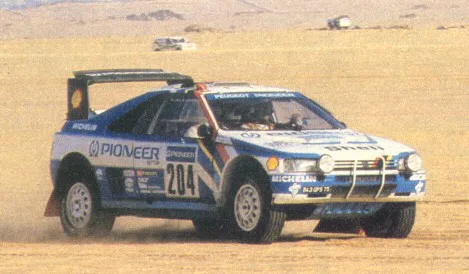
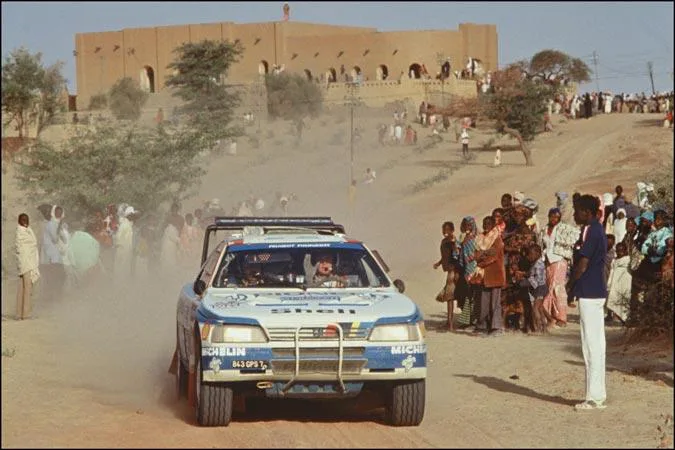
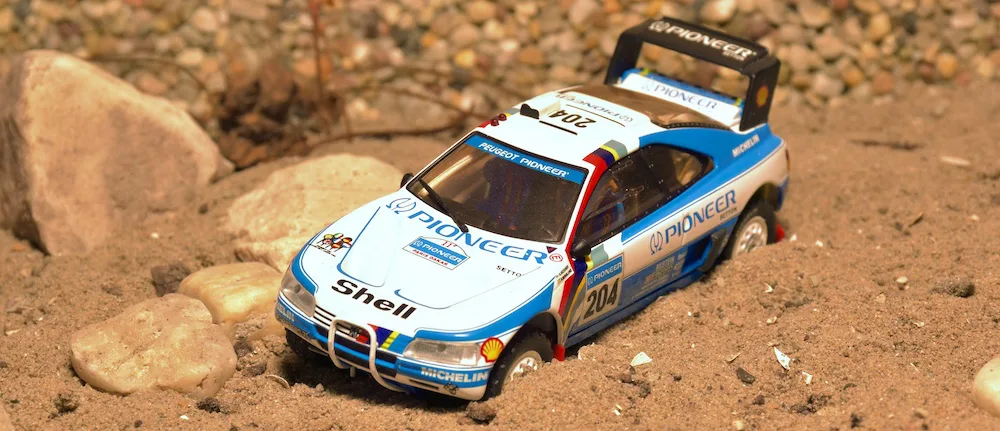
- IXO Historic rally cars RAC027 (diecast)
- Overall rating: 3 STARS | Quality details: 3 STARS | Estimated value: 3 STARS
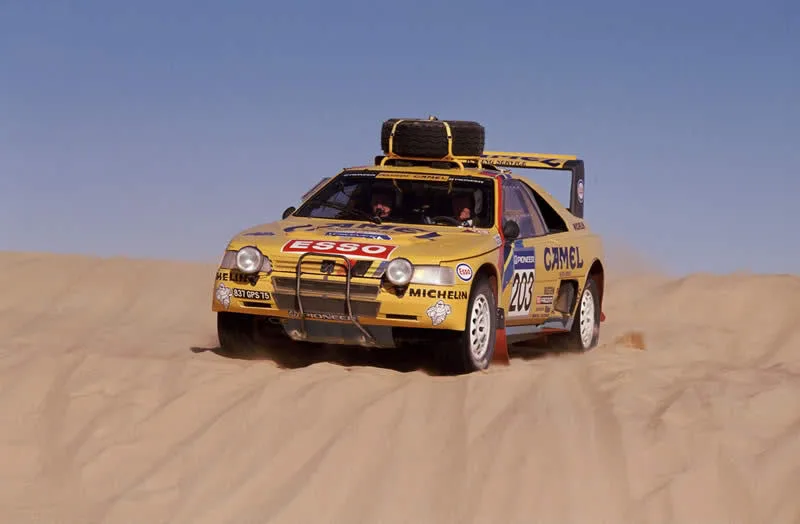
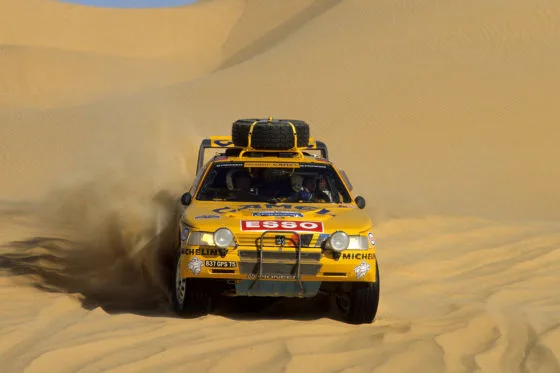
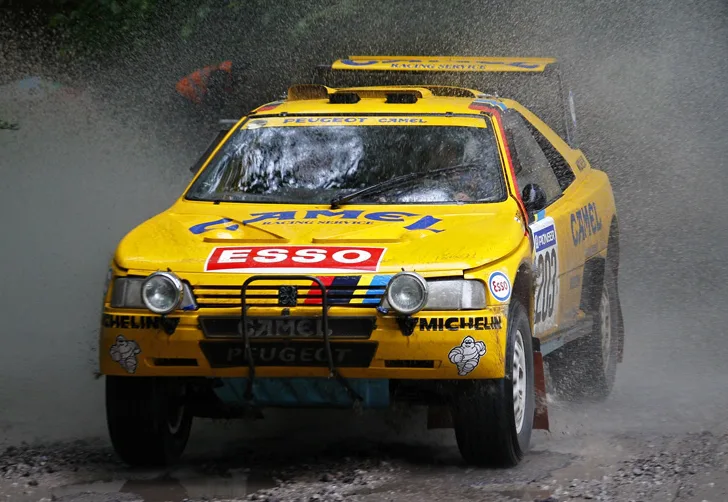
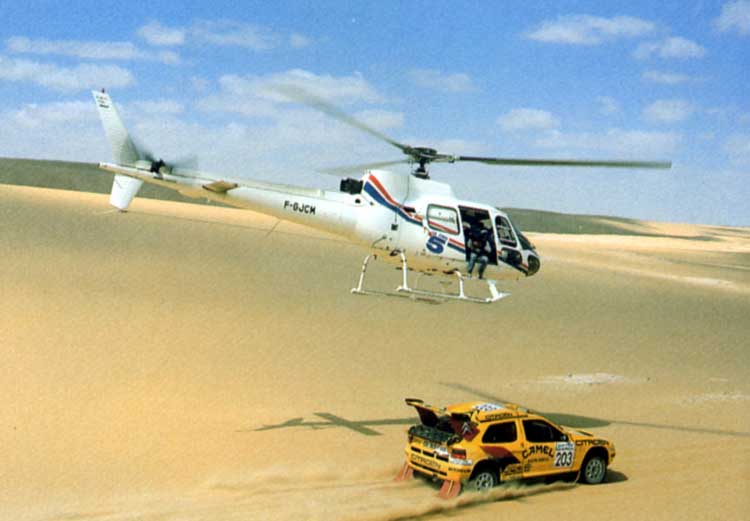
1990 Paris – Tripoli – Dakar, Peugeot 405 “Grand Raid”. Camel was back as the main sponsor for the Peugeot team, but the rest remained almost unchanged. Ari Vatanen flew to victory in the 405 “Grand Raid”. The second 405 was piloted by another former world rally champion, veteran Bjørn Waldegard. He finished second and Alain Ambrosino third in the old 205 T16.
#203 Ari Vatanen (FIN) / Bruno Berglund (S) – 1st
Peugeot Sport Peugeot 405 “Grand Raid” – 1.9 liter PSA XU9T straight-4 turbo, approx. 400 hp. Michelin tires. Weight 1300 kg. Steel monocoque with subframes, chassisnr. unknown. 4WD
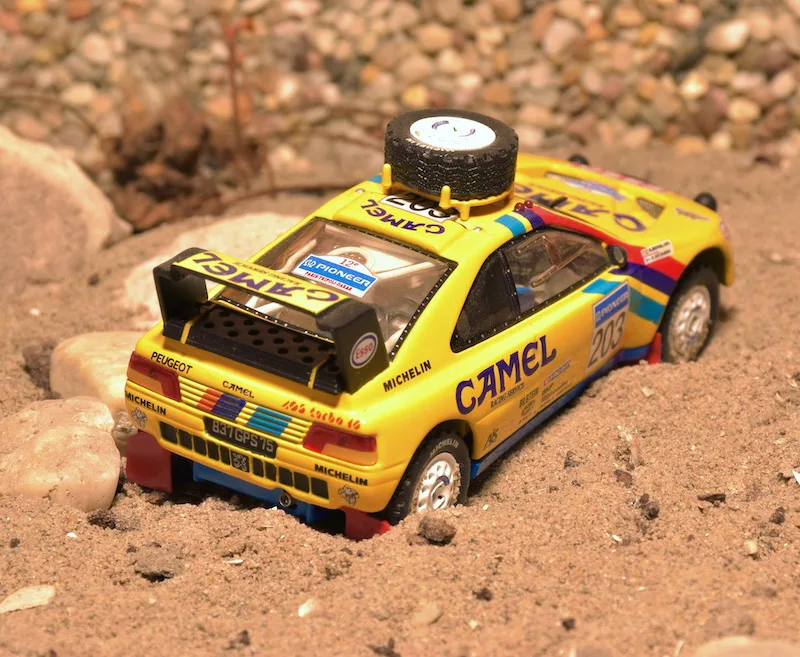
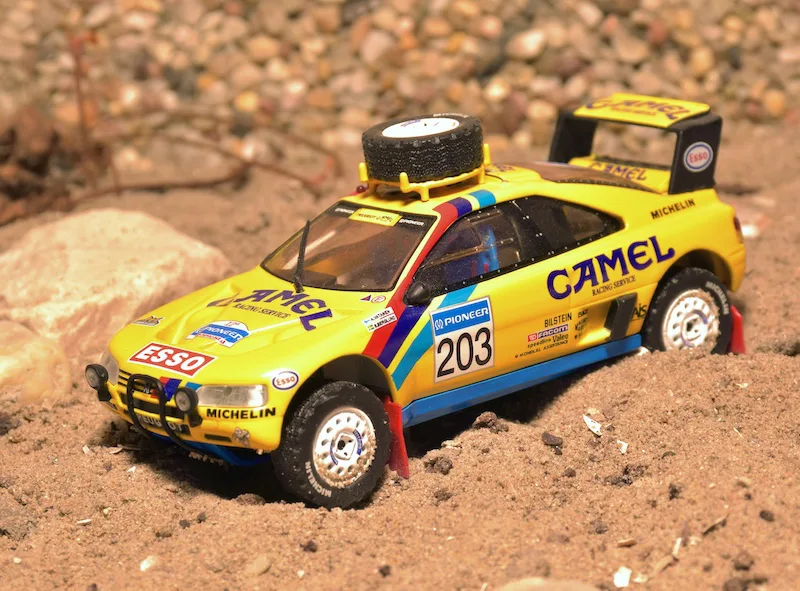
- IXO Historic rally cars RAC041 (diecast)
- Overall rating: 3 STARS | Quality details: 3 STARS | Estimated value: 3 STARS
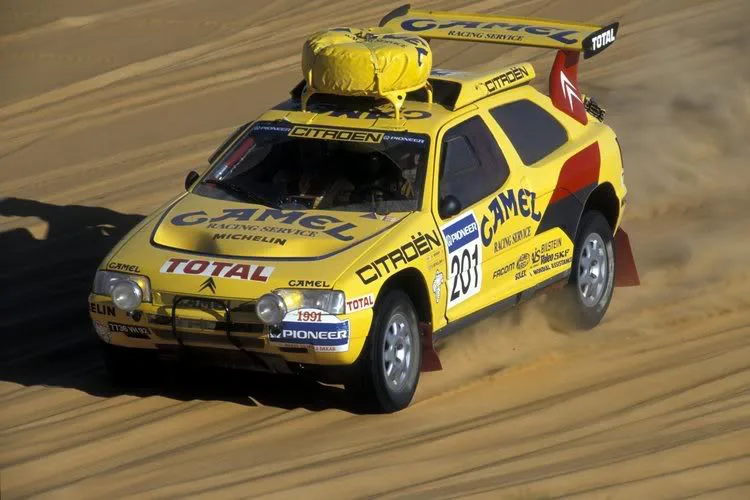
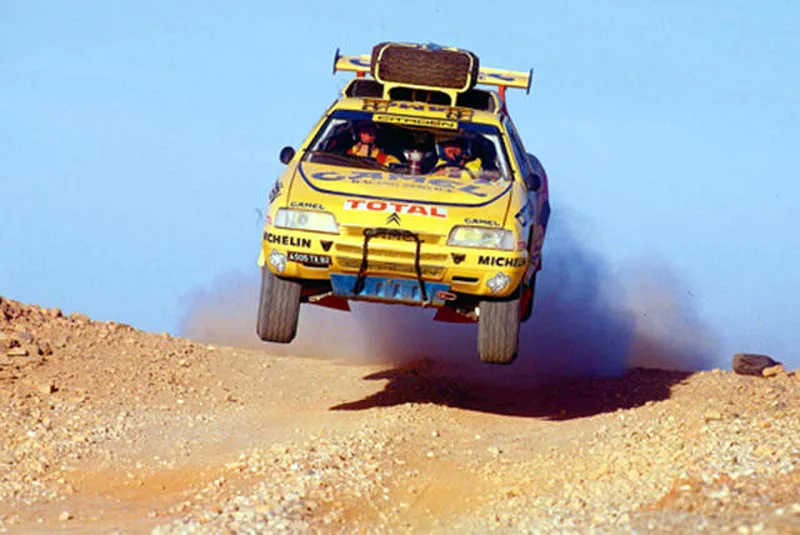
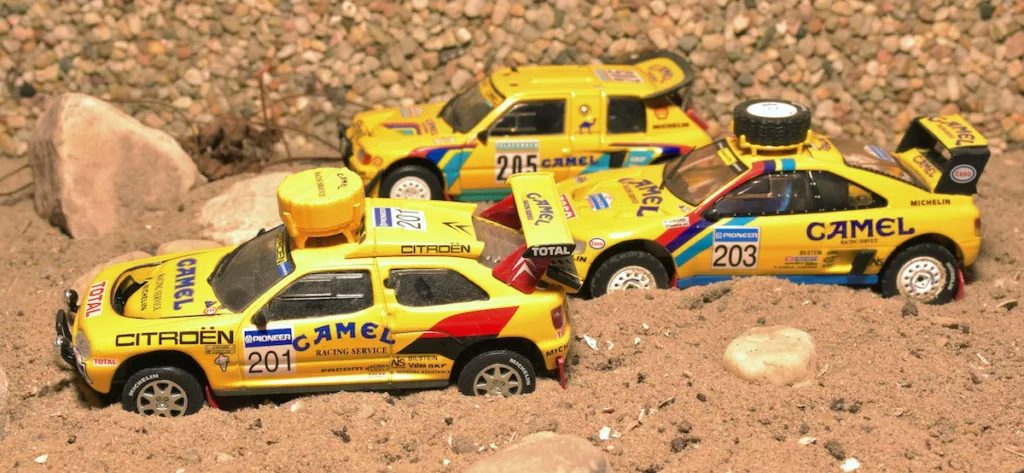
1991 Paris – Tripoli – Dakar, Citroën ZX Rally Raid. Flying Finn Ari Vatanen had won 3 times with Peugeot in 1987, 1989 and 1990. In 1991 Peugeot traded Dakar for Le Mans and sister company Citroën took over with the ZX Rally Raid, which in fact was a re-bodied Peugeot 405 “Grand Raid” with some adjustments such as a new 7-speed gearbox. It was a marketing stunt, the street version of the Citroën ZX – a 5-door hatchback – would be launched a few months later and what’s a better PR-stunt than present it as a Dakar winner. Vatanen didn’t disappoint and won a record 4th time. Mitsubishi finished 2nd, 3rd and 4th all more than 3 hours behind.
#201 Ari Vatanen (FIN) / Bruno Berglund (S) – 1st
Citroën Sport Citroën ZX Rally Raid – 2.0 liter PSA XU9T straight-4 turbo, approx. 400 hp. Michelin tires. Weight 1320 kg. Steel monocoque with subframes, chassisnr. Citroën #C21. 4WD
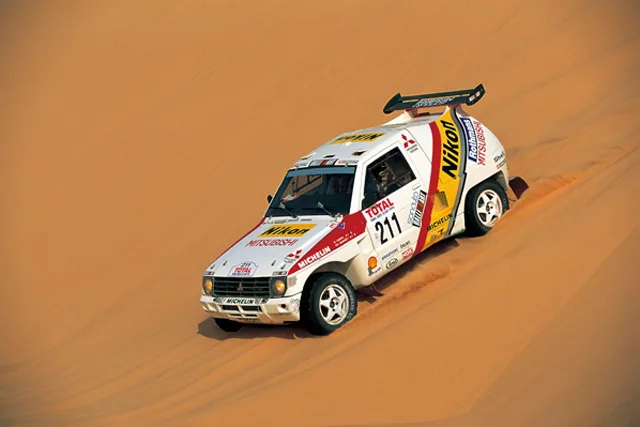
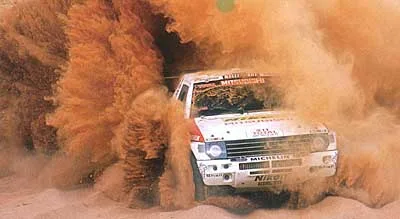
1992 Paris – Sirte – Cape Town, Mitsubishi Pajero Sport. For the first time since 1979, the rally will not conclude in Dakar, but in Cape Town in South Africa. It’s also the first time that GPS is allowed in the rally. Philippe Monnet is a sailor with GPS experience and he navigates Hubert Auriol – already two times winner in the bike category – to victory. Auriol drove for Citroën last year, finishing 5th. Mitsubishi takes the entire podium, Citroën – last year’s winner – follows in the places 4 until 7.
#211 Hubert Auriol (F) / Philippe Monnet (F) – 1st
RalliArt Mitsubishi Pajero Sport – 2.2 liter Mitsubishi 4G63 straight-4 turbo, approx. 320 hp. Michelin tires. Weight 1300 kg. Steel ladder chassis, chassisnr. SBM #unknown. 4WD
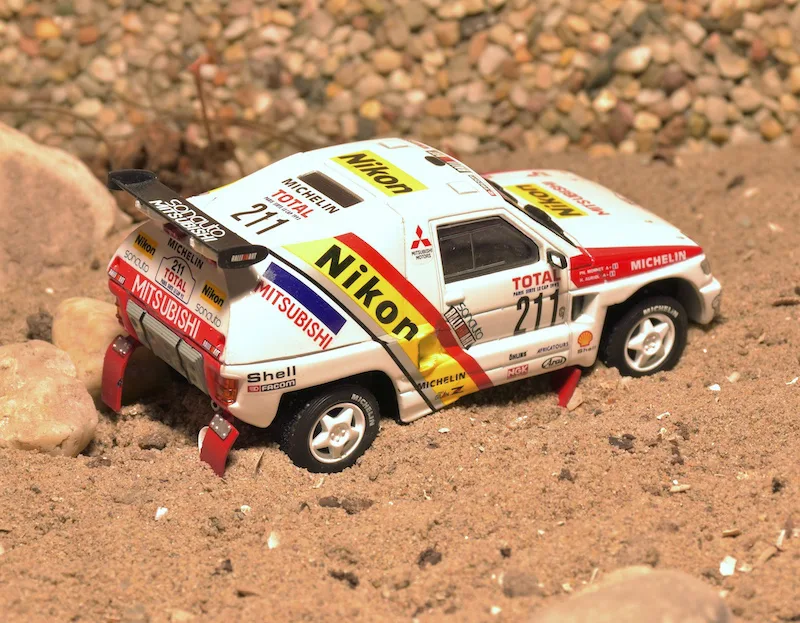
- NOREV Le Légende du Dakar 17 (diecast)
- Overall rating: 3 STARS | Quality details: 3 STARS | Estimated value: 2 STARS
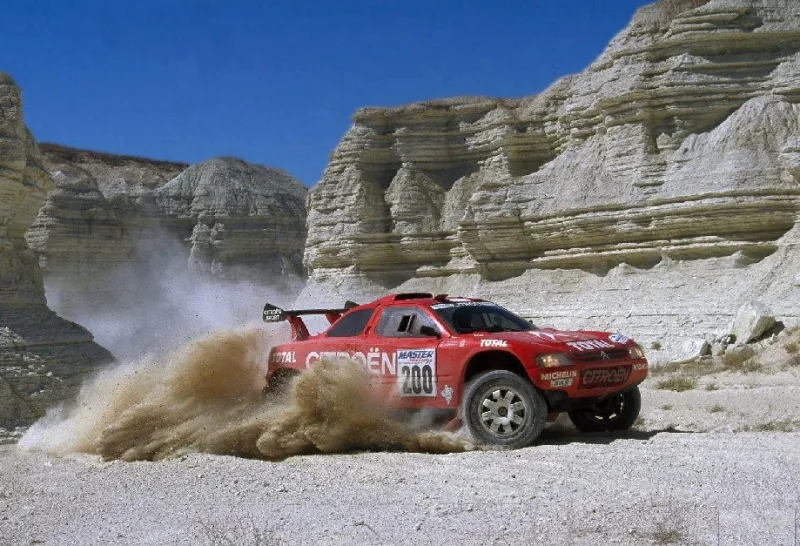
1995 Grenada – Dakar, Citroën ZX Rally Raid evo 3. Mitsubishi won the race to Cape Town in 1992, in 1993 Saby won again for Citroën and in 1994, 1995 and 1996 it was former Mitsubishi driver Pierre Lartigue who won for Citroën three times in a row. He drove the most developed version of the ZX Rallye Raid, the Evo 3 with 2.5-liter engine that developed its power and torque by lower revs. Also it had a wider track and improved aerodynamics.
#200 Pierre Lartigue (F) / Michel Perin (F) -1 st
Citroën Sport Citroën ZX Rally Raid evo 3 – 2.5 liter PSA XU15T straight-4 turbo, approx. 400 hp. Michelin tires. Weight 1300 kg. Steel monocoque with subframes, chassisnr. Citroën #C321. 4WD
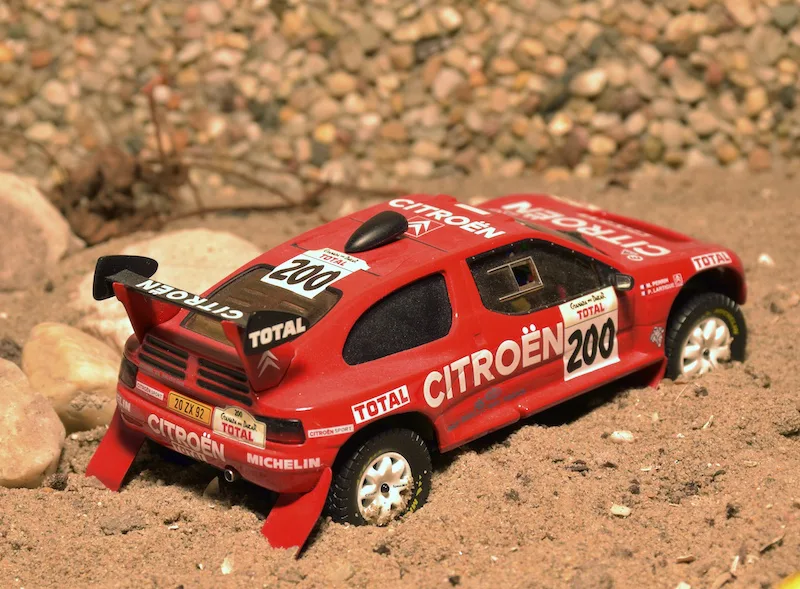
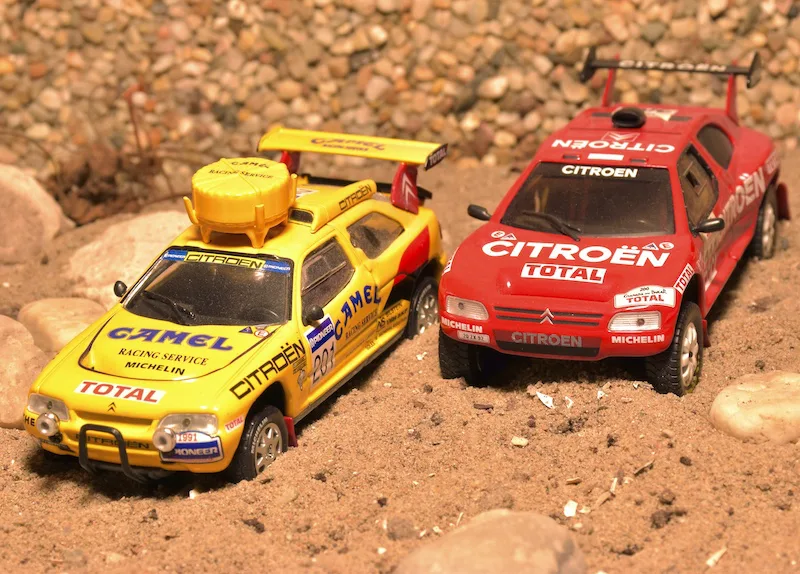
- IXO Historic rally cars RAC035 (diecast)
- Overall rating: 3 STARS | Quality details: 3 STARS | Estimated value: 3 STARS
1998 Paris – Grenada – Dakar, Mitsubishi Pajero evo. Mitsubishi and Dakar go back until 1983 when Andrew Cowan won the marathon class. Cowan has led Mitsubishi towards 9 overall victories since then. Kenjiro Shinozuka was the first Japanese winner in Dakar in 1997 and he finished 2nd in 1998 behind Fontenay and in front of Saby. All were driving factory Mitsubishi’s. Mitsubishi only had to deal with the Schlesser buggy as Citroën left competition after 1996.
#204 Kenjiro Shinozuka (J) / Henri Magne (F) – 2nd
#205 Bruno Saby (F) / Dominique Serieys (F) – 3rd
#206 Jean-Pierre Fontenay (F) / Gilles Picard (F) – 1st
RalliArt Mitsubishi Pajero evo – 3.5 liter Mitsubishi 6G74 V6 turbo, approx. 260 hp (restricted). Weight 1500 kg. Steel chassis, Mitsubishi MPR6 #unknown. 4WD
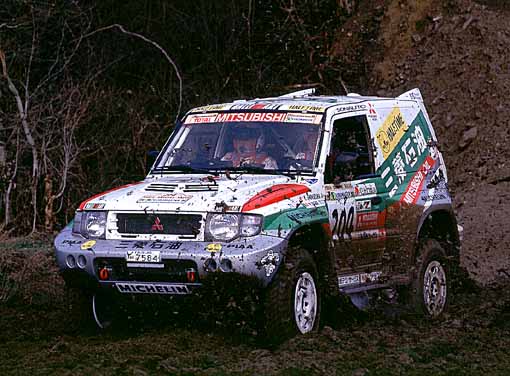
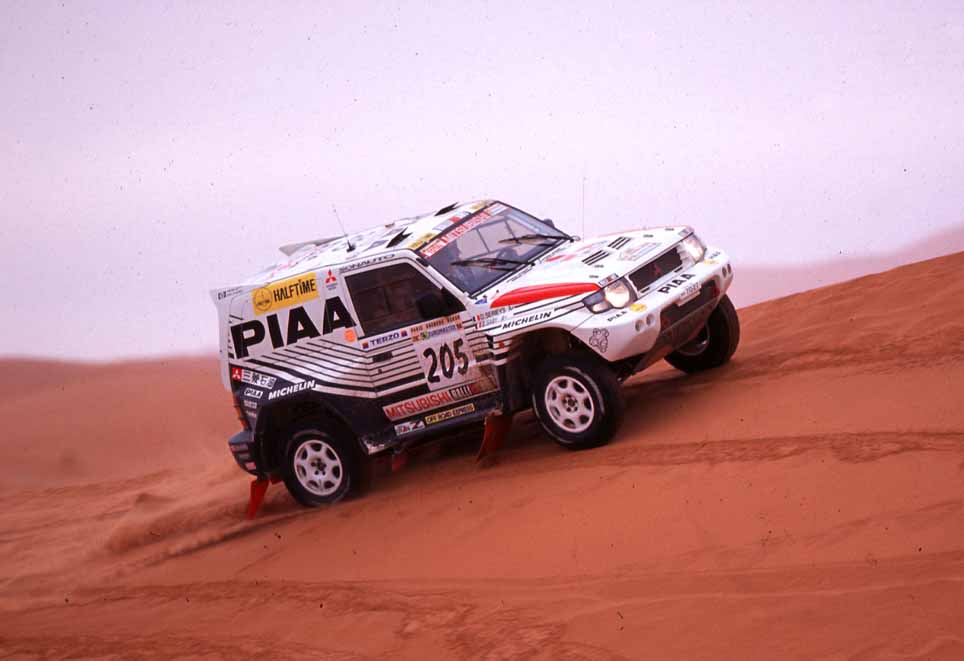
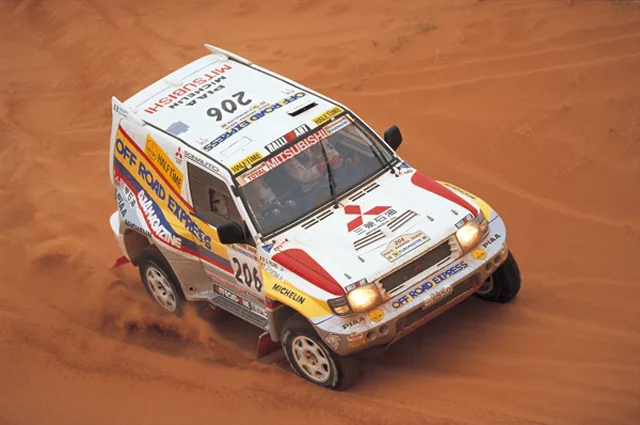
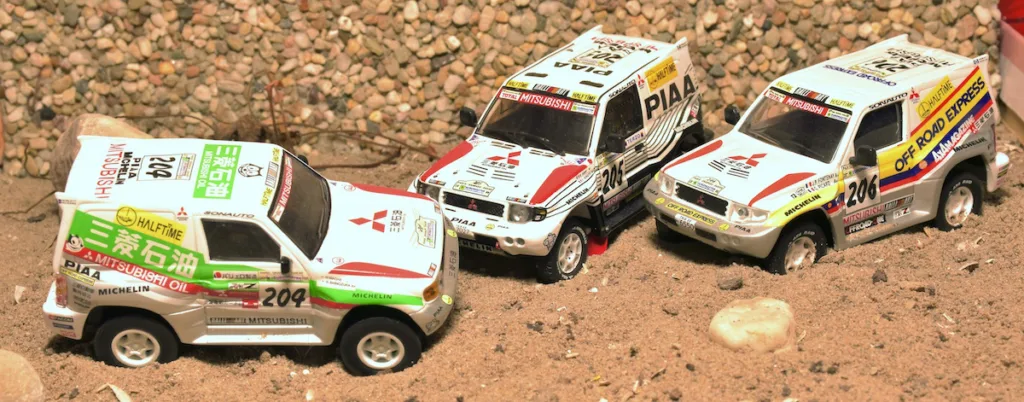
- #204 IXO Altaya #unknown (diecast)
- #205 SKID SKM 99068 (diecast)
- #206 IXO Altaya #unknown (diecast)
- Overall rating: 3 STARS | Quality details: 2 STARS | Estimated value: 2 STARS
1999 Grenada – Dakar, BMW F650 RR. In 20 years Dakar only 6 men managed to win the motorbike category: Cyril Neveu (5x), Hubert Auriol (2x), Gaston Rahier (2x), Stéphane Peterhansel (6x), Edi Orioli (4x) and Gilles Lalay (1x). In 1999, Richard Sainct added his name to the list, he would also become a multiple winner with victories in 2000 and 2003. Sadly, Sainct died during the Rallye of Egypt in 2004 while he was training for the 2005 Dakar.
#12 Richard Sainct (F) – 1st
BMW F650 RR – 678 cc BMW 1 cylinder, approx. 75hp. Michelin tires. Weight 168 kg. Steel frame, number unknown.
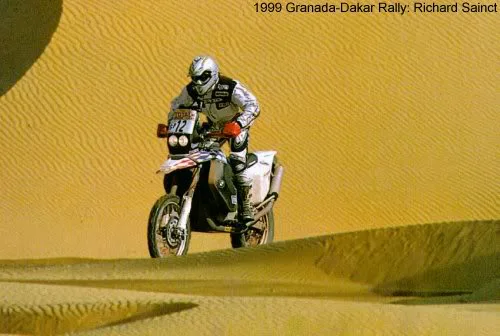
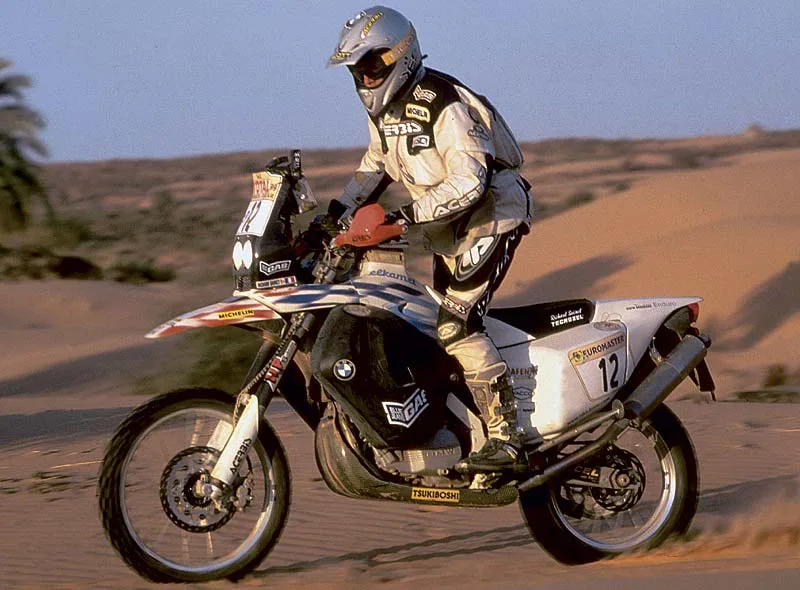
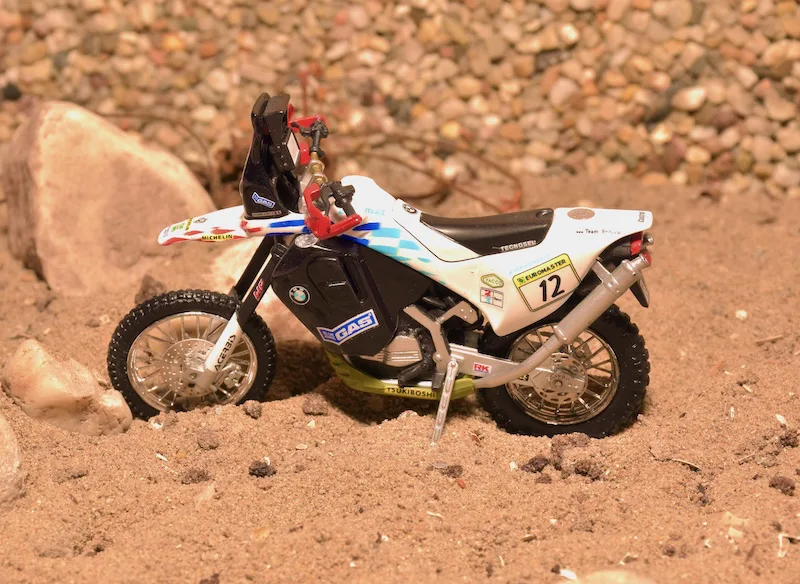
- DE AGOSTINI #unknown (plastic, scale 1:24)
- Overall rating: 2 STARS | Quality details: 1 STAR | Estimated value: 1 STAR
Trucks
1984 Paris – Algers – Dakar, Mercedes Unimog. The truck category in 1984 was by far not as competitive as nowadays. The majority of trucks that competed were also service vehicle for the participating car and bike teams. Same for this Unimog that performed service for the Italian Yamaha team. An Unimog is not a fast car, but it never gets stuck. The Italian crew finished 2nd in the truck category.
#503 Paolo Bonera (I) / Valerio Grassi (I) / Paolo Travaglia (I) – 2nd trucks
Yamaha Italia Mercedes Unimog U1300 4×4 – 5.7 liter Mercedes straight-6 turbodiesel, approx. 130 hp. Tires unknown. Weight 5000 kg. Steel ladder fra me, chassisnr. unknown. 4WD
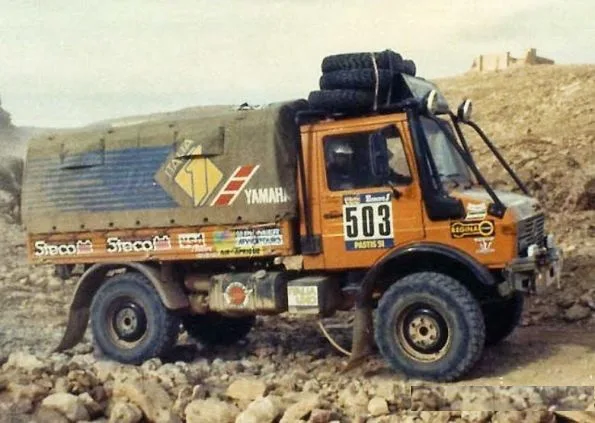
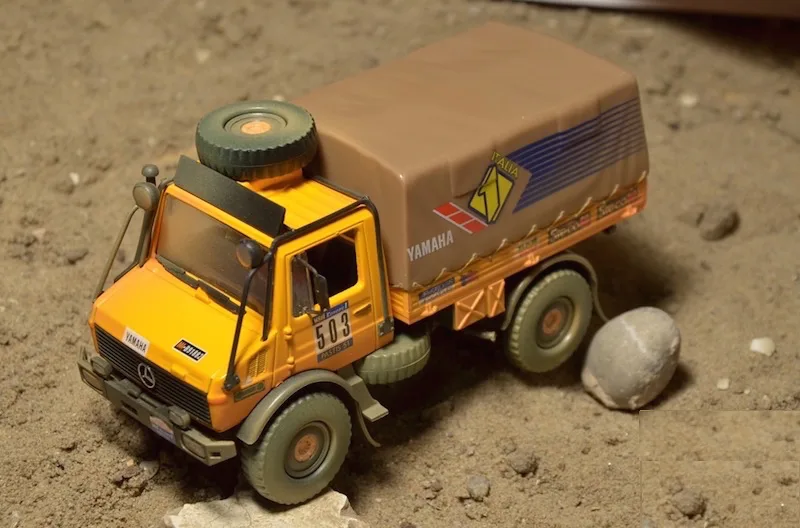
- DE AGOSTINI #unknown (plastic scale 1:43)
- Overall rating: 1 STAR | Quality details: 1 STAR | Estimated value: 1 STAR
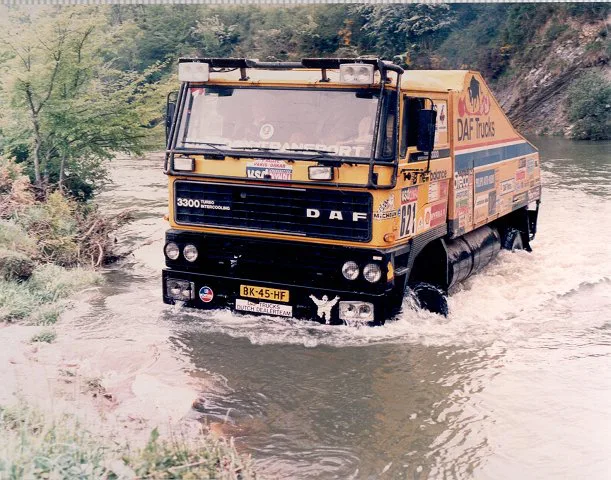
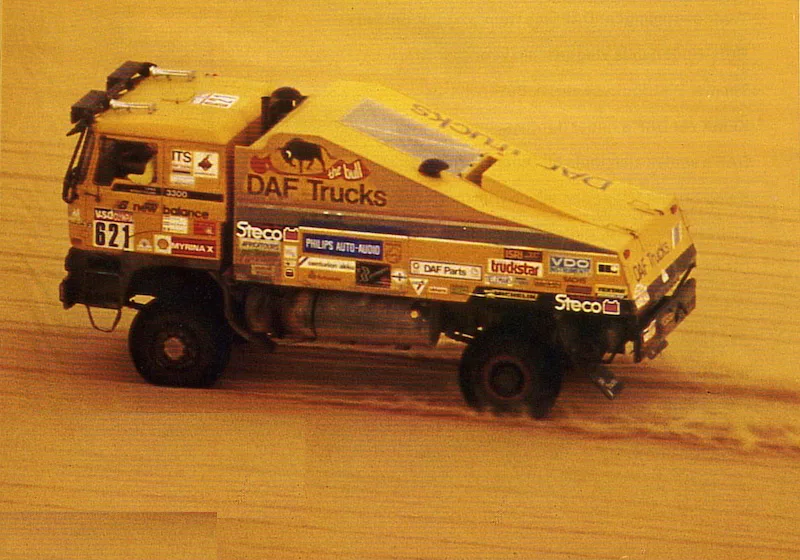
1985 Paris – Algers – Dakar, DAF F3300 “The Bull”. Jan de Rooy is a former rallycross champion driving a 4WD DAF. Since 1981 he competed in “Le Dakar”. His DAF trucks have beautiful names and look different each year. In 1985 he drives “The Bull”, the second DAF truck that is equipped with 2 engines. Team De Rooy finishes 2nd in the overall truck-ranking, and win the heavy category for trucks of 10.000 kg and over. The two headed truck from 1984 “Janus” competed as flying service for The Bull.
#621 Jan de Rooy (NL) / Thierry de Saulieu (F) / Martin Ketelaars (NL) – 2nd truck / 1st in class
Team De Rooy DAF F3300 – 2 x 11.6 liter DAF DKX 1160 straight-6 turbodiesel, approx. 2 x 450 hp. Michelin tires. Weight 11000 kg. Steel ladder frame, chassisnr. unknown. 4WD
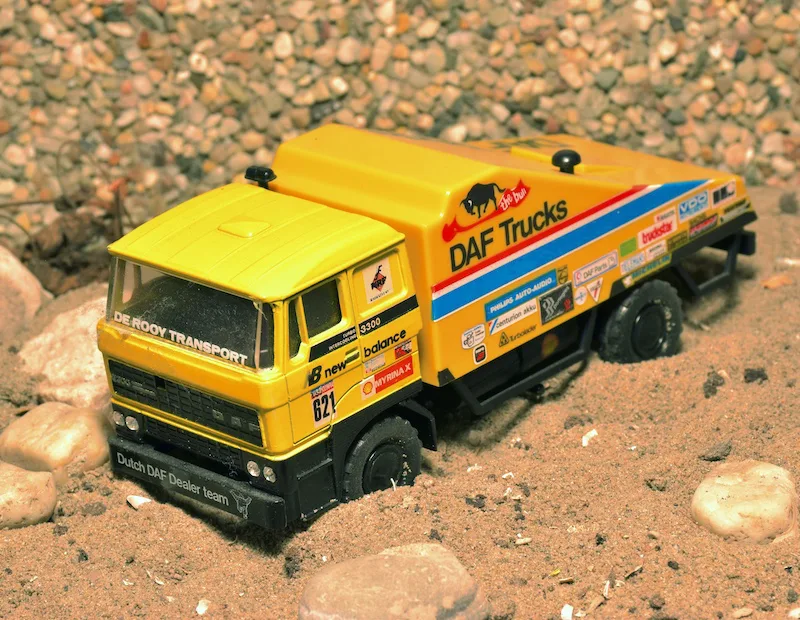
- PORTEGIES #unknown (plastic scale 1:50)
- Overall rating: 2 STARS | Quality details: 2 STARS | Estimated value: 2 STARS
In 1986, Jan de Rooy raced the DAF TurboTwin. I was lucky enough to be present during the 1986 prologue in Cergy Pontoise at December 29th 1985 and saw these monstrous trucks perform on a cold and snowy track.
Enjoy my pics 😉

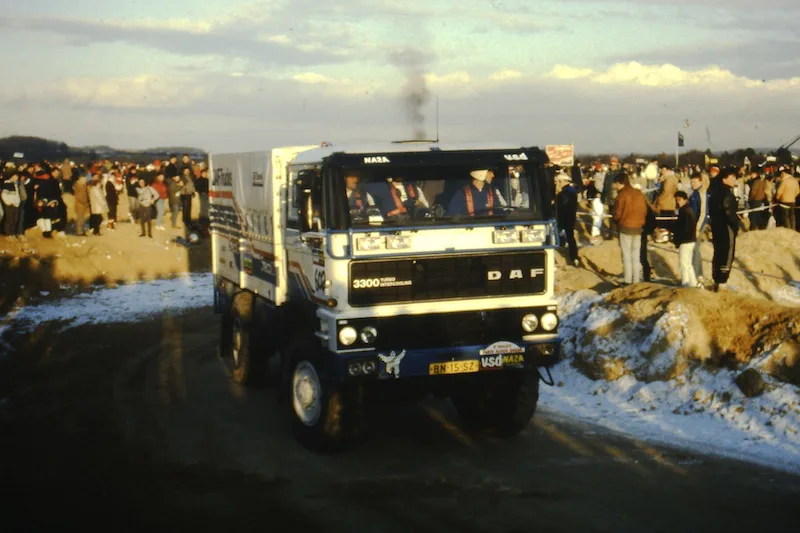
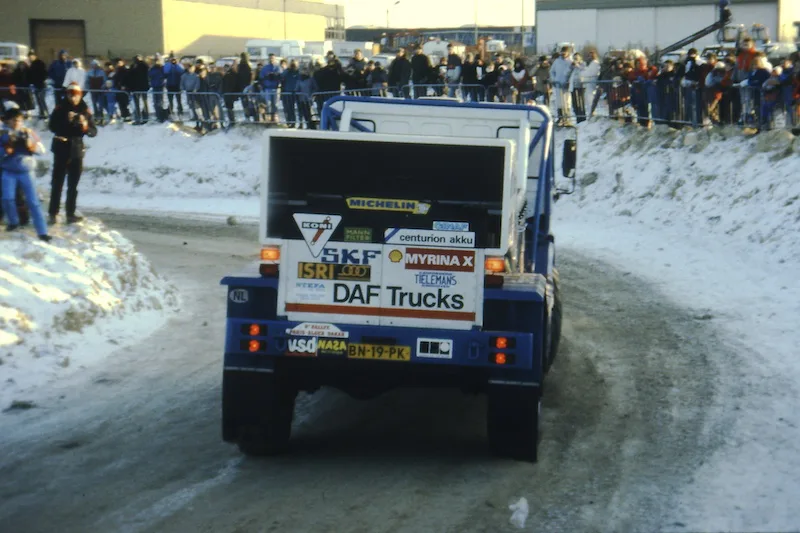
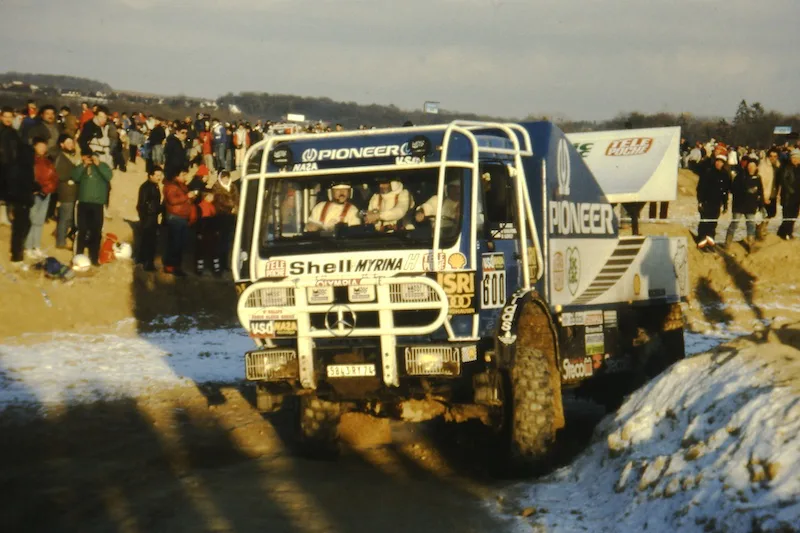
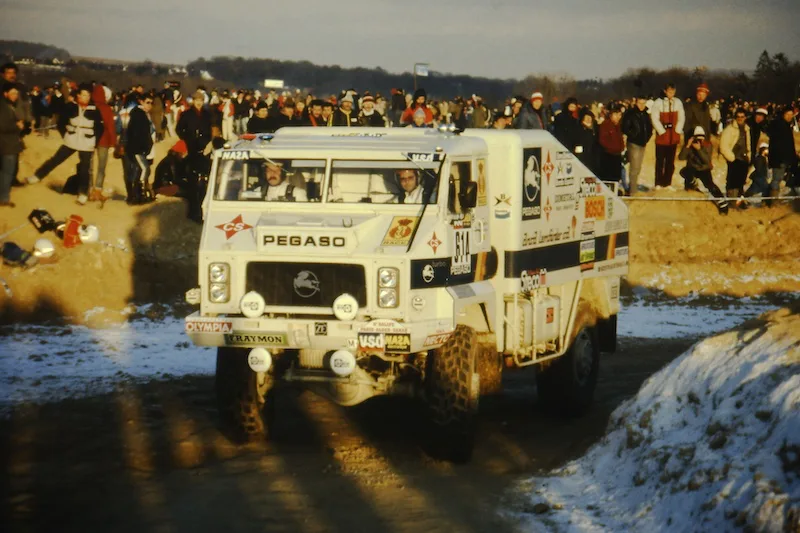

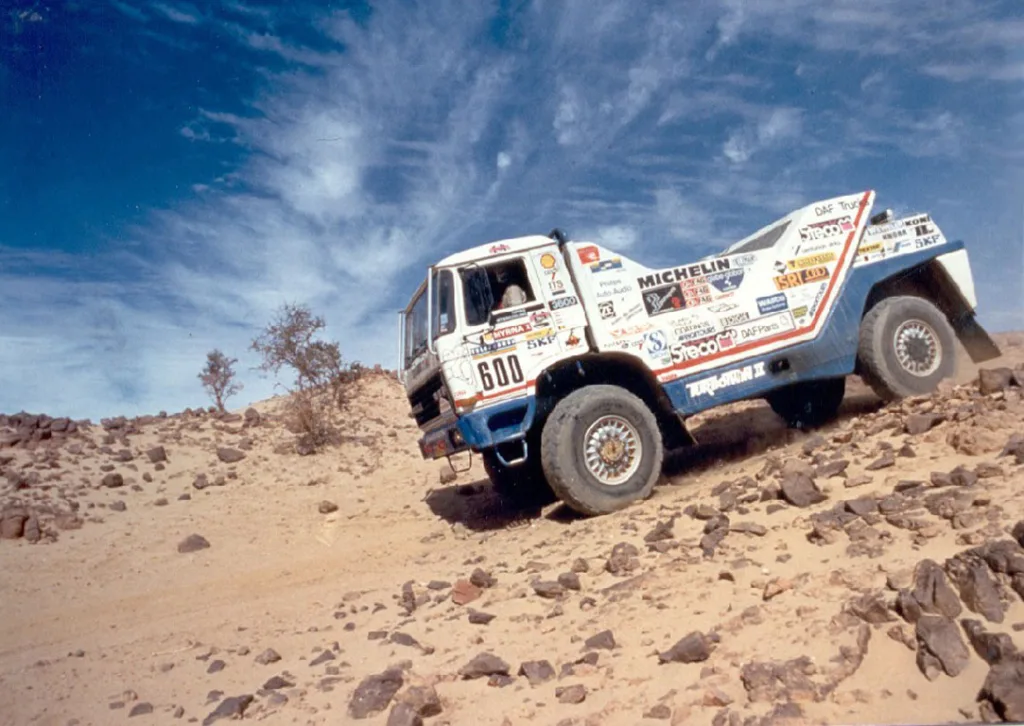
1987 Paris – Algers – Dakar, DAF 3600 “Turbo Twin II”. Jan de Rooy his “Turbo Twin II” smashes the competition. Not only in the truck category which he wins by 14 hours, he finishes 11th overall. The two DAF engines deliver at least 500 hp each and the Turbo Twin is capable of reaching 180 km/h!
#600 Jan de Rooy (NL) / Yvo Geussens (B) / Theo van de Rijt (NL) – 11th / 1st truck
Team De Rooy DAF F3600 – 2 x 11.6 liter DAF DKX 1160 straight-6 turbodiesel, approx. 2 x 500 hp. Michelin tires. Weight 10500 kg. Steel ladder frame, chassisnr. unknown. 4WD
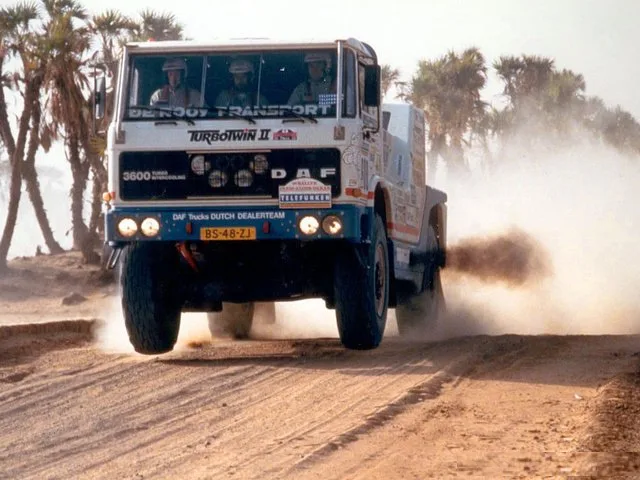
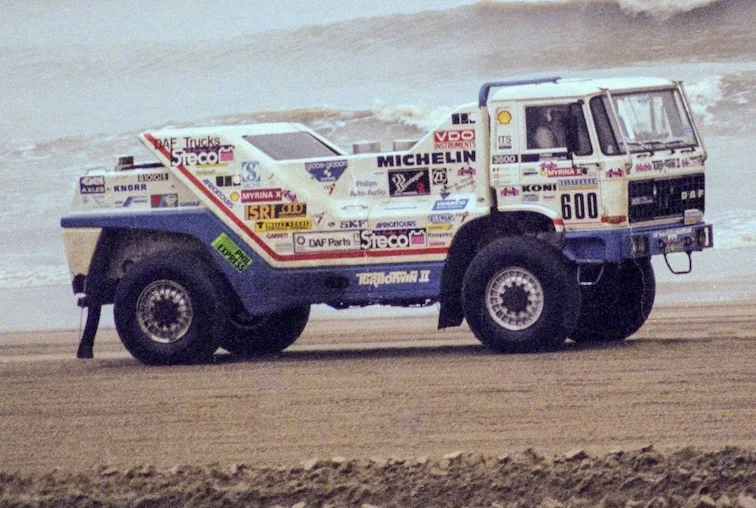
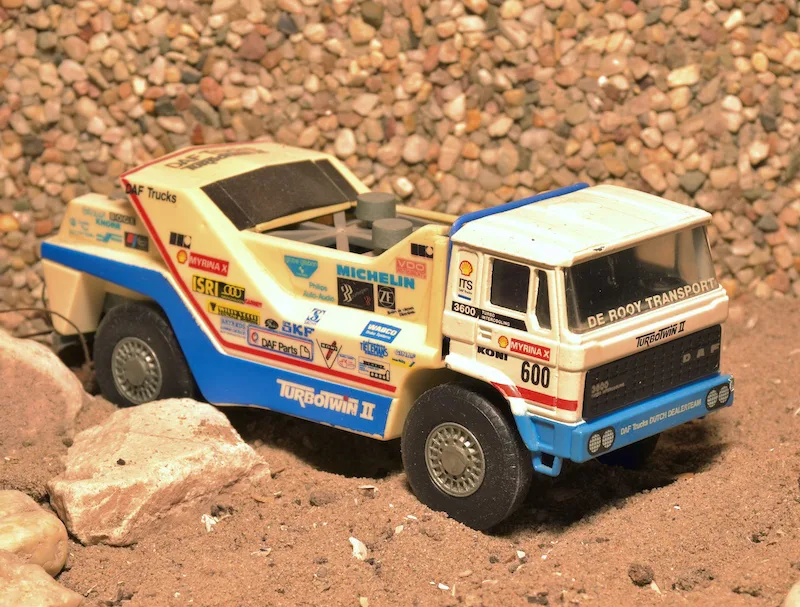
- PORTEGIES (plastic scale 1:50)
- Overall rating: 2 STARS | Quality details: 2 STARS | Estimated value: 2 STARS
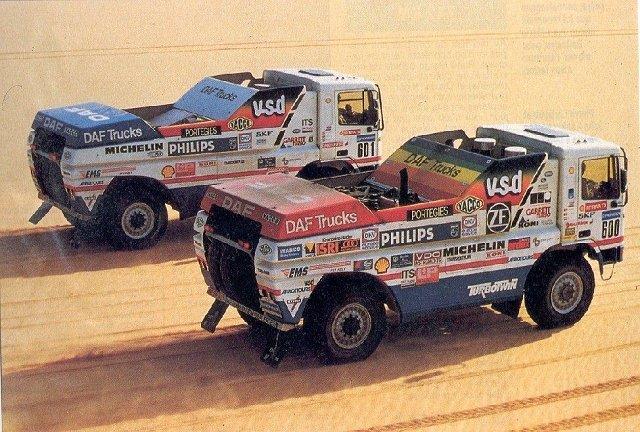
1988 Paris – Algers – Dakar, DAF 95 “Turbo Twin X1”. Jan de Rooy was very ambitious and aimed for a top 5 spot in the overall rankings. Truck manufacturer DAF wanted to make sure that DAF would win the truck category, so a second truck (X2) was prepared as back-up in case De Rooy would retire. The X1 had an aluminium space frame and 3 turbo’s per engine, developing over 1200 hp. It had a top speed of more than 200 km/h in the sand, the aerial shot where De Rooy passes the Peugeot 405 “Grand Raid” of a surprised Ari Vatanen in the desert is legendary (see video). Sadly, the second DAF crashes and one of the crew members dies in a horrific accident where he is thrown out of the car, still attached to his seat. DAF immediately withdraws and announces its departure from Dakar to the displeasure of Jan de Rooy who wanted to continue.
#621 Jan de Rooy (NL) Yvo Geussens (B) / Hugo Duisters (B) – DNF
Team De Rooy DAF 95 X1 – 2 x 11.6 liter DAF DKX 1160 straight-6 turbodiesel, approx. 2 x 610 hp. Michelin tires. Weight 10000 kg. Aluminium space frame, chassisnr. X1. 4WD
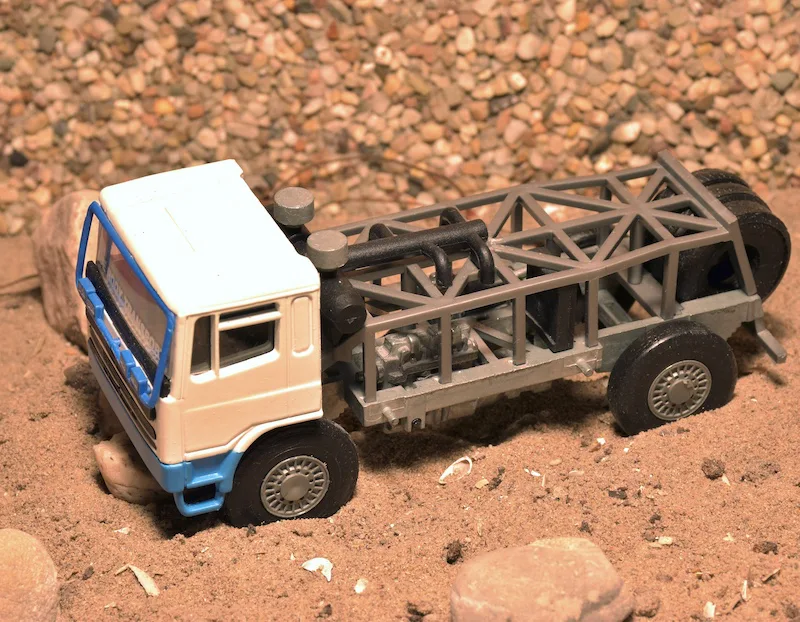
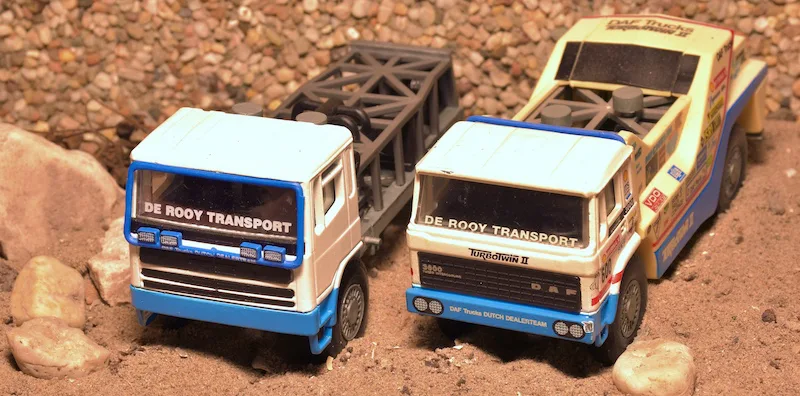
- PORTEGIES (plastic scale 1:50)
- Overall rating: 2 STARS | Quality details: 2 STARS | Estimated value: 2 STARS
Thanks for visiting 😉